Sri Lankan spices wholesale: which grade name is on your pepper, clove, nutmeg or cardamom offer?
Truly Ceylon export team ·
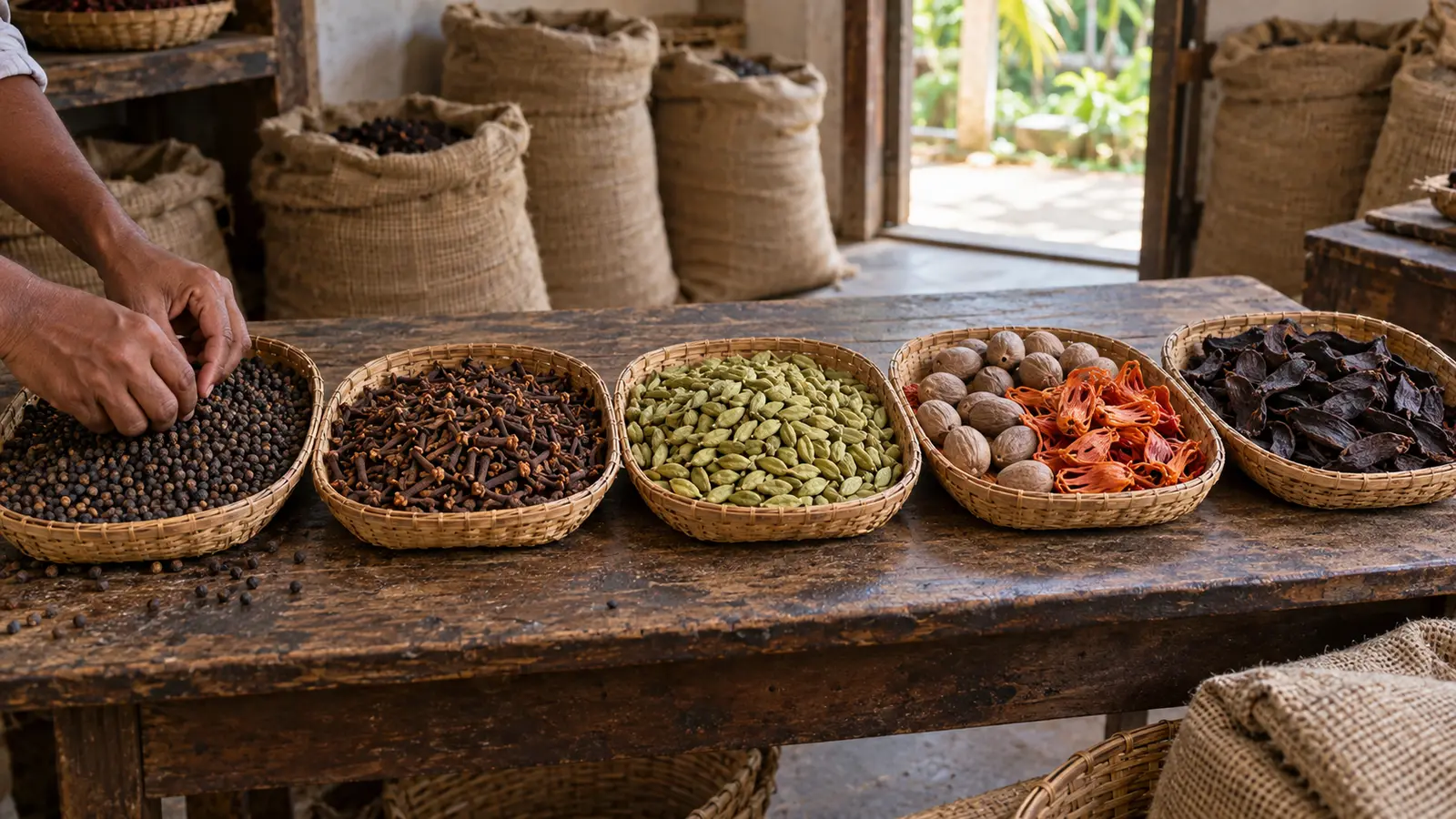
Buying Sri Lankan spices wholesale comes down to one decision before any talk of price: the exact spice, form and grade your enquiry will name. Beyond cinnamon, the spices Sri Lankan suppliers export most are pepper, cloves, cardamom, nutmeg, mace and vanilla, with ginger, turmeric and goraka alongside them. Pepper, cloves, cardamom, nutmeg and mace each carry official grade names, set out below. Seed spices such as coriander and cumin are a separate case: ask where they were grown before you ask anything else.
Which spices Sri Lanka grows for export
Sri Lanka's Export Development Board (EDB) says the spices Sri Lankan suppliers export most are cinnamon, pepper, cloves, cardamoms, nutmeg, mace and vanilla, and that ginger and turmeric are also exported.
The second body to know is the Department of Export Agriculture (DEA). Its crop pages cover cardamom, clove, ginger, goraka, nutmeg, pepper, turmeric and vanilla. The grade names below come from those pages.
Cinnamon is graded on the diameter of the quill and has a guide of its own: Ceylon cinnamon grades from Alba to Hamburg. For the other spices, product listings start from the Sri Lankan spices category.
Official grade names at a glance
The table pairs each spice with the grade names on its DEA crop page and with its heading in Sri Lanka's export tariff, taken from the EDB list of HS codes for export spices. An HS code is the customs classification number of a product.
| Spice | Official grade names | Export tariff heading |
|---|---|---|
| Black pepper | Special Grade I, Grade I, FAQ | H.09.04 |
| Cloves | Grade 1, Grade 2, Grade 3 | H.09.07 |
| Cardamom | Lanka Green, Lanka Light Green 1, Lanka Light Green 2, Lanka Bleached, Lanka Non Specified | H.09.08 |
| Nutmeg with shell | Grade 1, Grade II, B.W.P. | H.09.08 |
| Shelled nutmeg | Large, Medium, Small, B.W.P. | H.09.08 |
| Mace | Grade I Special, Grade I, Grade II | H.09.08 |
A grade name is shorthand for a set of limits. The sections below give the limits the DEA publishes for each spice.
Black pepper: three grades, two measures
The DEA gives the botanical name of pepper as Piper nigrum L. Black pepper is the dried whole fruit. White pepper is made by removing the outer pericarp, the outer layer of the fruit.
The Department of Export Agriculture pepper page lists three Sri Lanka Standards grades for black pepper:
- Special Grade I: 12% moisture and a maximum of 4% light berries.
- Grade I: 14% moisture and a maximum of 4% light berries.
- FAQ: 14% moisture and a maximum of 10% light berries.
Special Grade I and Grade I differ on moisture. Grade I and FAQ differ on light berries. FAQ on a pepper offer is a grade name, not a page of questions.
Density returns in the tariff. Under heading H.09.04, Sri Lanka's export tariff separates whole pepper into light berries with a density up to 450 g/L and heavy berries with a density over 450 g/L, with separate lines for white, crushed and ground pepper. Ask which line the lot will be declared under.
The whole black pepper listing is the place to start a pepper enquiry.
Cloves: three grades, four limits
The DEA gives the botanical name of clove as Syzygium aromaticum L. The main product is the dried whole bud.
The Department of Export Agriculture clove page lists three Sri Lanka Standards grades, and four limits separate them:
- Moisture: a maximum of 12% for Grade 1 and Grade 2, and 14% for Grade 3.
- Extraneous matter: a maximum of 1%, 2% and 3% by mass.
- Short cloves: cloves below 10 mm in length are limited to 15% by mass in Grade 1 and 25% in Grade 2.
- Khuker cloves: limited to 3%, 5% and 10% in Grades 1, 2 and 3.
"Khuker" is the grade list's own word. Ask for the khuker percentage on the test report.
The DEA says the clove season usually runs from December to the end of April, depending on locality, and that well-dried cloves, at 8-10% moisture, can be stored in gunny bags for 1 or 2 years without fungus or insect damage. Ask which season the lot comes from. For the whole bud, see the whole cloves listing.
Cardamom, nutmeg and mace
Cardamom: five names based on colour, splits and weight
The DEA lists cardamom in the family Zingiberaceae. It is grown at elevations over 600 m and has five grades: Lanka Green, Lanka Light Green 1, Lanka Light Green 2, Lanka Bleached and Lanka Non Specified. They are graded by colour, percentage of splits and weight per litre. Ask for the split percentage and the weight per litre as figures on the offer.
Nutmeg and mace: say "with shell" or "shelled" first
The botanical name of nutmeg is Myristica fragrans. Nutmeg and mace are the two main products of the same tree, and the DEA says both are used to flavour curries, confectionery, bakery products and beverages.
The Department of Export Agriculture nutmeg page lists three sets of names. Nutmeg with shell is Grade 1, Grade II or B.W.P., which stands for Broken, Wormy, Punky. Shelled nutmeg is Large, Medium, Small or B.W.P. Mace is Grade I Special, Grade I or Grade II, with extraneous matter not above 1% by mass.
Ginger, turmeric, vanilla and goraka: specify by form
The DEA describes three ginger types, local, Chinese and Rangoon, and lists dried ginger, bleached ginger, ginger slices, ginger powder, ginger oil and ginger oleoresin as value added products. A ginger enquiry should name both the type and the form.
Goraka is the Sinhala name the DEA uses for Garcinia quaesita, which has been used for culinary purposes. Dried goraka is the rind of the ripe fruit, with the seeds removed, dried under sunlight until it turns dark black.
Ginger and turmeric share export tariff heading H.09.10. This guide has no official grade names for ginger, turmeric, vanilla or goraka, so specify them by plant and form and ask for the supplier's specification sheet.
Seed spices: ask where they were grown
A Sri Lankan spice offer may also include coriander, cumin, fennel, fenugreek or mustard seed. None of the five is among the crops on the DEA crop pages listed earlier. Shipment from Sri Lanka does not by itself show where a seed spice was grown.
Ask the supplier to write the country of origin of each seed spice on the offer. The Department of Commerce asks exporters of spices and allied products for extra documents when they register for certificates of origin, including a supplier list, warehouse details and an auditor's report. If you plan to claim a tariff preference with a certificate of origin, confirm with your customs broker which origin the goods can carry before you order.
How to write a wholesale spice enquiry
- Name the spice, the plant and the form. "Black pepper, Piper nigrum, whole" leaves less room for error than "pepper". Sri Lanka's National Plant Quarantine Service asks for correct botanical names on the packing list when a phytosanitary certificate, the official plant health certificate, is applied for.
- Write the official grade name. For example "Special Grade I", "Grade 2", "Lanka Green" or "shelled, Medium".
- Add the limits you buy against. Moisture, light berries, extraneous matter, splits. Ask for each result on a test report.
- Give the tariff heading and your own import code. The Department of Commerce explains that the first six digits of an HS code are agreed by all countries, while national tariff lines of 8 to 10 digits can differ between countries.
- Ask for the country of origin of every seed spice. Have it written on the offer.
- List the certificates before the goods are packed. The EDB's export procedure guide (2020) says quality, health, phytosanitary and fumigation certificates and test reports are submitted when the buyer requests them. The guide to export documents from Sri Lanka covers who issues each paper.
- Request a sample and a pro-forma invoice. Check that the grade name on the pro-forma invoice, the supplier's written offer, matches your enquiry.
Destination rules to check before you order
A Sri Lankan grade describes the lot. The rules of your own market decide whether it clears. In the European Union, maximum residue levels (MRLs) for pesticides are set under Regulation EC 396/2005, and a general default MRL of 0.01 mg/kg applies where a pesticide is not specifically mentioned.
Rules change. Confirm the requirements for your product with your customs broker or on the authority's own page before you order.
Common mistakes
- Ordering "pepper" or "cloves" with no grade name. The supplier then chooses the grade for you, and two offers cannot be compared.
- Comparing offers at different moisture levels. Special Grade I pepper is listed at 12% moisture and Grade I at 14%.
- Asking for "nutmeg" without saying with shell or shelled. The two forms use different grade names.
- Assuming every spice on a Sri Lankan offer was grown in Sri Lanka. Ask for the origin of coriander, cumin, fennel, fenugreek and mustard seed in writing.
- Leaving certificates until the goods are packed. They are prepared when the buyer requests them, so ask in the enquiry.
Frequently asked questions
Which spices does Sri Lanka export besides cinnamon?
The Export Development Board says the spices Sri Lankan suppliers export most are cinnamon, pepper, cloves, cardamoms, nutmeg, mace and vanilla, and that ginger and turmeric are also exported.
What are the grades of Sri Lankan black pepper?
The Department of Export Agriculture lists three Sri Lanka Standards grades: Special Grade I, Grade I and FAQ. They are separated by moisture, at 12% or 14%, and by the maximum share of light berries, at 4% or 10%.
What does B.W.P. mean on a nutmeg offer?
B.W.P. stands for Broken, Wormy, Punky. The Department of Export Agriculture lists it as a grade of nutmeg with shell and of shelled nutmeg.
Are coriander and cumin seeds sold from Sri Lanka grown in Sri Lanka?
Do not assume so. Neither is among the crops on the Department of Export Agriculture crop pages used for this guide, so ask the supplier to state the country of origin in writing.
Which tariff headings cover Sri Lankan pepper, cloves, nutmeg and cardamom?
In Sri Lanka's export tariff, whole pepper sits under heading H.09.04, cloves under H.09.07, and nutmeg, mace and cardamoms under H.09.08. Your own import code may be longer, so check it with your customs broker.
Once the list is written, with the spice, form, grade name, limits, quantity, destination port and certificates, send it as one message through the Truly Ceylon quote request page. Ask for the specification sheet and the country of origin of every line in the same message.
Key takeaways
- Beyond cinnamon, the spices Sri Lankan suppliers export most are pepper, cloves, cardamom, nutmeg, mace and vanilla.
- Black pepper has three grades, Special Grade I, Grade I and FAQ, separated by moisture and light berries.
- Cardamom has five "Lanka" grade names, and nutmeg grade names depend on whether it is with shell or shelled.
- Coriander, cumin, fennel, fenugreek and mustard seed need a written country of origin on the offer.
- Name the grade, the limits and the certificates in the first enquiry, and confirm destination rules with your customs broker.
Sourcing from Sri Lanka?
Send us the product, quantity, packing and destination port for a written quotation.