Moringa leaf powder import: will your label make it a food or a supplement?
Truly Ceylon export team ·
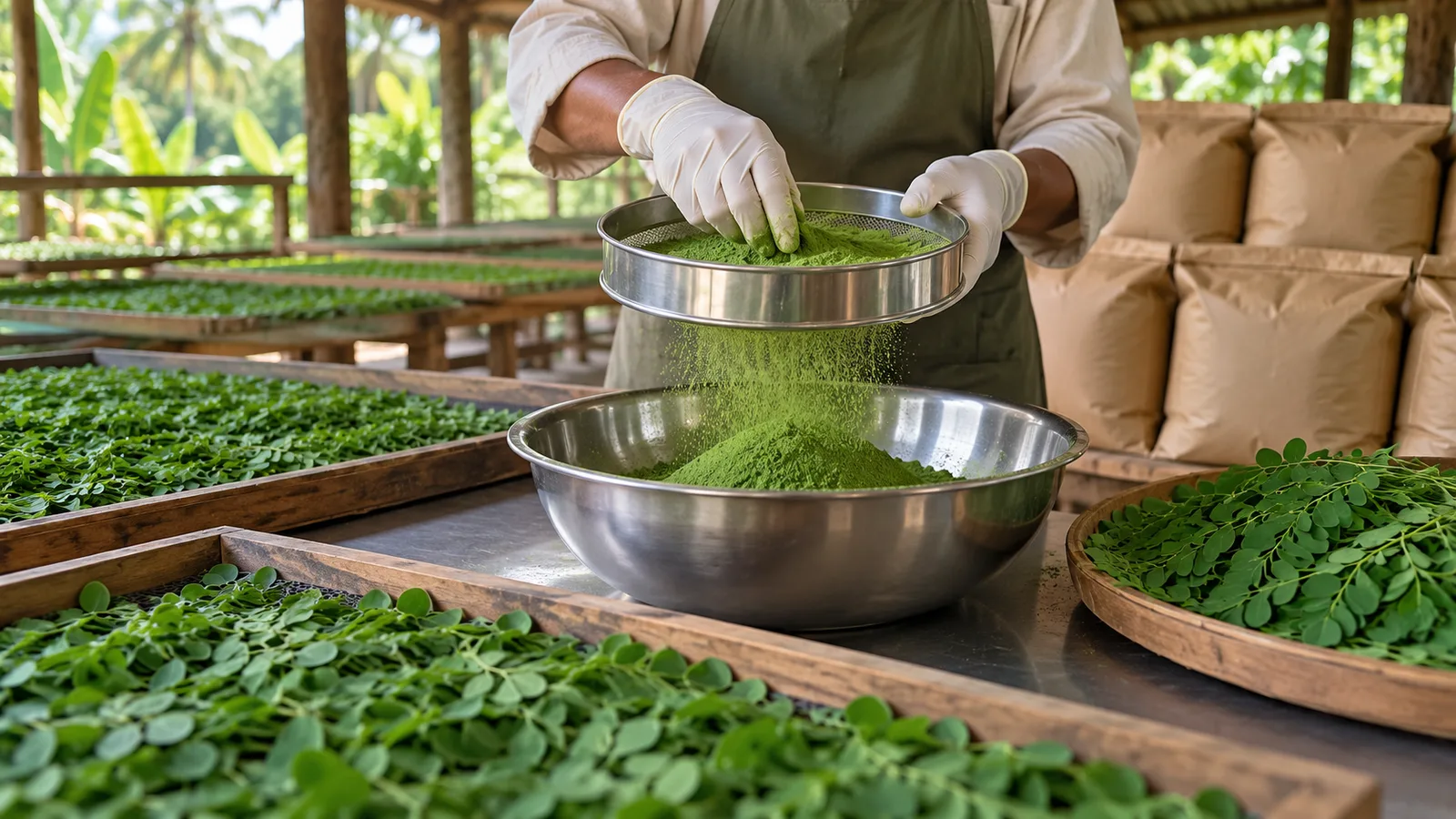
Before you import moringa leaf powder in bulk, and before you ask a bulk supplier for a price, decide what the powder will be in your market: a food ingredient, a tea, or a product sold in capsules or tablets with claims on the pack. That choice, more than the powder itself, decides which papers you need from Sri Lanka and which rules apply when the goods land. Below are the documents to name, the residue limits to test against and the label wording that can move a bag of leaf powder into a different set of regulations.
What moringa powder is in Sri Lankan trade
Moringa is the drumstick tree. The Export Development Board (EDB), Sri Lanka's export promotion body, uses the name murunga for the moringa pod that Sri Lanka exports, and you will see that word on some offers and packing lists. The pods, the leaves and the powder are three different products, so name the one you want.
The EDB's page on Sri Lankan foods marketed under the superfood label says the seed pods are cooked as a vegetable, the leaves are eaten as a leafy vegetable, and moringa powder is used in baking. Elsewhere the EDB says the leaves are boiled to make moringa herbal tea. Those are the uses an origin description can rest on.
The same EDB page calls "superfoods" a marketing term coined by the industry. Treat the word that way on your own labels. It names a sales category, not a property of the product.
Food, tea or supplement: the label decides the rules
Two shipments of identical powder can fall under different rules, because regulators look at how a product is presented. This is the trap for buyers who plan a retail pack after the bulk order arrives.
At origin: food or herbal product
The EDB says herbal finished products must be approved by the Drug Formulatory Committee, appointed under the Department of Ayurveda, before they are sold locally or exported. The Department of Ayurveda publishes Form B for registering Ayurveda products and Form C for their import and export registration. A plain leaf powder shipped as a food ingredient is a different case from a finished herbal product in tablets. Ask the supplier which way your order will be exported, and ask for the approval paper if the answer is "herbal product".
In the United States: food or dietary supplement
The FDA regulates dietary supplements under a different set of regulations from conventional foods. Its questions and answers on dietary supplements say that under the Dietary Supplement Health and Education Act of 1994 the FDA does not have the authority to approve supplements before they are marketed, and that manufacturers and distributors are responsible for their safety and labelling. The FDA also says a product represented, explicitly or implicitly, for the treatment, prevention or cure of a specific disease is treated as a drug, not a dietary supplement. One sentence on a capsule box can change the category.
In the EU: check the novel food status yourself
For EU buyers, the open question is novel food status. This guide does not state the status of moringa leaf in the EU. Check the European Commission's Novel Food status Catalogue for the exact plant part and form you plan to sell, and confirm the result with your own food safety adviser before you sign a contract.
Papers to name in a moringa powder enquiry
The EDB's export procedure guide says quality certificates, health certificates, phytosanitary certificates, fumigation certificates and other test reports are submitted when the buyer requests them. None of them arrives by default, so list each one in your first message. Our checklist of export documents from Sri Lanka separates the standard shipping set from the papers you must request.
| Document | Who issues it in Sri Lanka | What to check on it |
|---|---|---|
| Export health certificate | Food Control Administration Unit (FCAU), Ministry of Health, only for registered establishments | The parameters your market asks for, stated on the certificate |
| Quality certificate | Sri Lanka Standards Institution (SLSI) or SGS, per the EDB's herbal export page | The lot it covers and the date of testing |
| Certificate of analysis | Industrial Technology Institute (ITI), for herbal extracts and natural products | Pesticide residue results against your market's limits |
| Phytosanitary certificate | National Plant Quarantine Service, after inspection and sampling, before dispatch | The correct botanical name of the plant on the packing list |
| Organic certificate | An accredited certification body, plus registration with the EDB's National Organic Control Unit | The standard named (for example EU, USDA-NOP or JAS) and the product in scope |
| Drug Formulatory Committee approval | The committee appointed under the Department of Ayurveda | Needed when the product is exported as a herbal finished product |
The FCAU's export certification page adds two points that matter for powders. A factory inspection is a pre-requisite for its health certificate, and for each consignment it asks for an application, a product sample and analysis reports, usually testing a sample at a laboratory it recognises. Different countries request different parameters, so tell the supplier what your importing authority wants to see on the certificate.
For a wider list of questions with the paper behind each answer, see what to ask a food supplier before a first order.
Pesticide residues: test against the destination limit
A leaf crop dried into a fine powder is a product where residue testing deserves a line of its own in the contract. The EU sets maximum residue levels for pesticides under Regulation EC 396/2005. The limits apply to 315 fresh products and to the same products after processing, and a general default limit of 0.01 mg/kg applies where a pesticide is not specifically mentioned.
That default is the number to plan around. Ask the supplier which residues the analysis report covers, and name the EU regulation, or your own market's rule, as the reference on the order.
Sourcing questions that come before the price
The EDB says medicinal plants for export should come from the exporter's own cultivation or from controlled out-grower or community grower systems, and that the Department of Forest and the Department of Ayurveda have regulations to prevent the export of wild collections. Ask where the leaves are grown and how the grower system is controlled.
Ask too which tariff code the supplier will declare. The EDB lists HS heading 1211 (plants and parts of plants used in perfumery, pharmacy and similar purposes) and heading 0910 (ginger, turmeric and other spices) among the codes for Sri Lanka's ayurvedic and herbal exports. Which line fits your powder is a decision for your customs broker, but the code on the supplier's papers and the one on your import declaration should agree.
What your own market adds
The export papers are only half of the file. Each destination adds its own steps, and our guide to how Sri Lankan food import rules differ by destination sets them out market by market. For moringa powder, three points stand out.
- United States: the facility that makes, packs or holds the powder must be registered with the FDA, prior notice is filed for each shipment, and the US importer keeps a Foreign Supplier Verification Programs plan.
- Canada: the importer needs a Safe Food for Canadians licence and a preventive control plan covering how the foreign supplier makes, packs and labels the food.
- Japan: the Plant Protection Station says items used as ingredients for spices and herbal medicines are among those that need import inspection, and every food import needs a notification under the Food Sanitation Act.
Australian buyers can check the conditions for dried plant products in the Biosecurity Import Conditions system (BICON) before ordering. Rules change, so confirm every requirement with your customs broker or the authority's own page.
How to order moringa powder in bulk, in order
- Decide the end use and the regulatory category in your market: food ingredient, tea, or a product with claims.
- Write the specification: plant part (leaf), form (powder), the residue reference you test against, organic status if needed, and the inner pack and outer carton.
- List the documents by name: health certificate, quality certificate, certificate of analysis, phytosanitary certificate, organic certificate, and the herbal approval if it applies.
- Ask for a sample and the specification sheet together. The EDB guide says trade samples are usually sent by airmail; test the sample against your market's limits.
- Check the pro-forma invoice. The EDB says it states the product description, quantity, price, payment terms, delivery terms and packing and marking details. Make sure the documents you listed are on it too.
- Agree the label text before packing, and leave out any wording about effects on the body unless your market's rules allow it.
Common mistakes
- Ordering "moringa" without naming the part and form, so a quote arrives for pods or tea cut instead of leaf powder.
- Printing claims on a retail pack after a bulk order bought as a food ingredient, which can move the product into supplement or drug rules.
- Assuming test reports come with the shipment. They are supplied when the buyer asks for them.
- Accepting an old certificate of analysis. A report from another lot says nothing about yours.
- Selling in the EU without checking the novel food status of the exact product.
Moringa powder sits in the food and beverages category on this site, while moringa tablets and the moringa leaf drink are listed under herbal products. Our guide to what you can specify and claim on Sri Lankan herbal products covers the wider herbal range.
Frequently asked questions
Is moringa powder exported from Sri Lanka as a food or as a herbal product?
It depends on how the product is made and presented. The EDB says herbal finished products need approval from the Drug Formulatory Committee under the Department of Ayurveda before export, so ask the supplier which route your order takes and for the approval paper if it goes as a herbal product.
What residue limit applies to moringa powder in the EU?
The EU sets pesticide limits under Regulation EC 396/2005, and they apply to processed products as well as fresh ones. Where a pesticide is not specifically mentioned, a default limit of 0.01 mg/kg applies, so ask for an analysis report against the EU rule.
Does the FDA approve moringa powder before it is sold in the United States?
No. The FDA says it does not approve individual food products or labels, and under the 1994 supplements law it has no authority to approve dietary supplements before marketing. A product presented as treating, preventing or curing a disease is treated as a drug.
What is murunga?
Murunga is the name the Export Development Board uses for the moringa pod, the drumstick, that Sri Lanka exports. On an offer it usually means the pod, so write "moringa leaf powder" when you want the powder.
Which certificates should I ask for with organic moringa powder?
Ask for an organic certificate from an accredited body for your market's standard, such as EU, USDA-NOP or JAS. For the EU, organic imports also need an electronic certificate of inspection in TRACES, or they are not released at the port of arrival.
When your specification and document list are ready, send them through the how-to-order page with a request for a sample and the moringa powder specification sheet, then compare the written answer line by line with what your market requires.
Key takeaways
- Decide whether your moringa powder is a food, a tea or a supplement before you ask for a price.
- Name every certificate in the enquiry: test reports arrive only when you ask.
- Test against your destination's residue limit; in the EU the default is 0.01 mg/kg.
- Keep claims about effects on the body off the label unless your market's rules allow them.
- EU buyers check the novel food status of the exact product themselves.
Sourcing from Sri Lanka?
Send us the product, quantity, packing and destination port for a written quotation.