Ceylon tea regions: which of the seven districts belongs in your blend?
Truly Ceylon export team ·
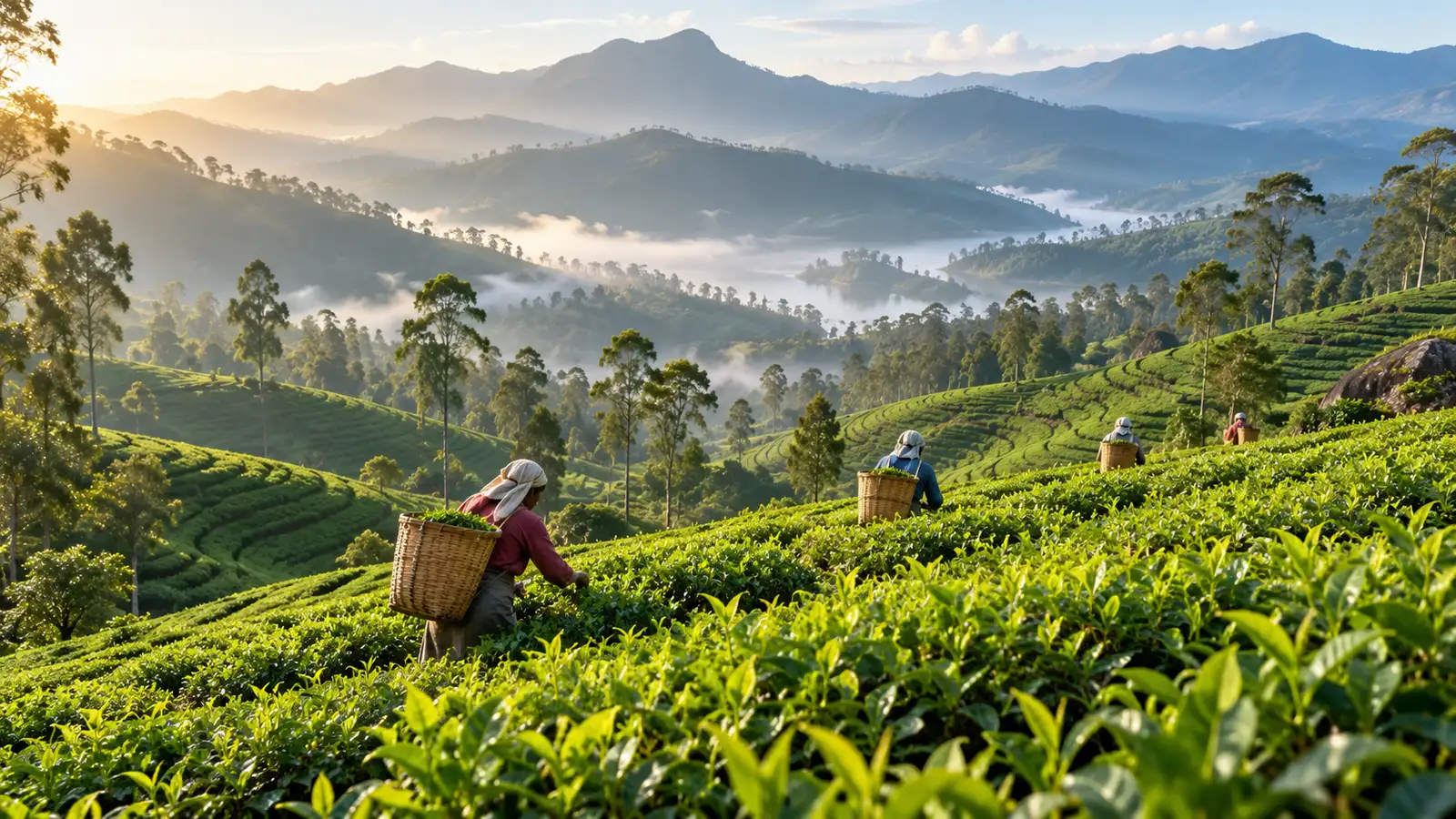
Ceylon tea regions are the seven tea-growing districts the Sri Lanka Tea Board names: Kandy, Nuwara Eliya, Uda Pussellawa, Uva, Dimbula, Sabaragamuwa and Ruhuna. For a blender or retailer, the district on the offer tells you roughly how the cup will behave, from the refined, lighter Nuwara Eliya teas grown highest in the hills to the dark, strong Ruhuna teas grown near sea level. This guide puts the Tea Board's elevation figures and cup descriptions for each district in one table, then shows how to write a district into an enquiry so that two offers can be compared like for like.
Districts and elevation bands: two ways to describe the same tea
An offer may describe Sri Lankan tea by district, which is a place, or by elevation band, which is a height range.
The Export Development Board (EDB), Sri Lanka's export promotion body, classes Ceylon tea by elevation: high grown from 1200 m upwards, medium grown between 600 m and 1200 m, and low grown from sea level up to 600 m.
The two do not line up neatly, because a district covers estates on different slopes. Kandy is the clearest case: the Tea Board describes it as mid-grown, but its range of 650m to 1,300m reaches just above the EDB's high-grown line. Uva's range of 1000 to 1600m also crosses that line. When the band matters to your label or your blend, ask for the estate elevation, not only the district.
The seven Ceylon tea regions compared
The table below uses the Sri Lanka Tea Board's own figures and wording. Two districts, Uda Pussellawa and Sabaragamuwa, have cup descriptions on the Tea Board's Ceylon Tea site but no elevation figure on the pages used here, so the table says so rather than guessing.
| District | Elevation (Tea Board) | Band | Cup, in the Tea Board's words |
|---|---|---|---|
| Nuwara Eliya | Averages 2,000m (6,000ft), higher than any other district | High grown | Refined |
| Dimbula | 1,100m to 1,600m (3,500-5,000ft) | High grown | Refreshingly mellow and smooth, with a fine golden-orange hue |
| Uva | 1000 to 1600m (3,000-5,000ft) | Medium to high, by estate | Exotic |
| Uda Pussellawa | Not given on the pages used here: ask for the estate elevation | Ask the supplier | Tangy |
| Kandy | 650m to 1,300m (2,000-4,000ft) | Mid-grown | Bright infusion with a coppery tone; strong, full-bodied and flavour packed |
| Sabaragamuwa | Not given on the pages used here: ask for the estate elevation | Ask the supplier | Strong, scarlet and stylish |
| Ruhuna | Not exceeding 600 m (2000 Ft) | Low grown | Dark, with strong rich notes; full-flavoured black tea |
The elevations come from the Tea Board's tea-growing regions pages, and the short cup descriptions from its Ceylon Tea site's tea diversity page. They describe a district in general, not the lot in front of you: a starting point for tasting, not a specification.
What the districts mean for a blender or retailer
Nuwara Eliya, the highest district, is where retailers selling a named single-district tea often start: the name is well known and the refined cup is distinct from the stronger low-grown teas. Start a quote from our Nuwara Eliya black tea listing.
Dimbula is the one district here where the Tea Board names a quality season: from around the turn of the year until March or early April. If you buy it through the year, ask which month a lot was made in.
Uva spans the medium and high bands, so two Uva offers can come from quite different heights; see our Uva black tea listing. Kandy and Uda Pussellawa are the usual side-by-side comparison for body and colour from the middle hills.
Ruhuna, in what is now the Southern Province, is the low-grown district, and the Tea Board calls full-flavoured black tea a distinctively unique Ruhuna speciality. With Sabaragamuwa, it is the usual comparison for a blend that needs strength and a dark cup; our Ruhuna black tea listing covers that side.
Region is half the specification: the grade is the other half
The district says where a tea was grown; the leaf grade says the size and form of the leaf, which changes how fast it infuses. An offer for "Uva tea" with no grade is not yet a specification.
The Tea Board's Ceylon Tea site lists whole and semi-leaf grades such as OP (Orange Pekoe, a term for leaf size, not flavour), FBOP (Flowery Broken Orange Pekoe, a coarser semi-leaf tea with some tips), Pekoe (tightly rolled, near-spherical leaf) and BOP1 (a well-twisted semi-leaf tea, usually from the low country). Among the broken grades, BOP (Broken Orange Pekoe) is the main broken grade and infuses faster than whole leaf, BOPF (Broken Orange Pekoe Fannings) has smaller particles suited to tea bags, and Dust 1 has the smallest particles, infusing quickly for commercial brewing.
In practice, a tea-bag blender and a loose-leaf retailer may both want Dimbula, but one needs BOPF and the other OP. Write both the district and the grade into every enquiry. The Ceylon tea category lists the districts and grades we take enquiries for, from the black tea grades to green and white teas.
The name and the logo: rules that follow the tea
Two rules decide what you can print on the pack.
- The name "Ceylon Tea". The EDB says tea described as Ceylon Tea must be grown and made entirely in Sri Lanka and cannot be blended with tea from elsewhere: even a blend that is 95% Sri Lankan tea cannot be marketed as Ceylon Tea.
- The Lion logo. The Lion logo is owned by the Sri Lanka Tea Board, which globally trademarked it in 1999 as the emblem of Ceylon tea. It may only be used on tea packed in Sri Lanka: an overseas packer cannot use it, even when the contents are wholly Sri Lankan tea. An exporter who wants to use it submits an application and the packs to the Tea Board's Tea Tasting Unit, hears the result within 3 working days of evaluation, and receives a certificate valid for one year.
A blender packing abroad therefore works without the logo. Check the label wording for your own market with your regulator or customs broker as well.
Quality checks before a district tea leaves Sri Lanka
The export checks are the same for every district. ISO 3720:2011 defines black tea and its basic requirements, and the EDB says ISO 3720 is the minimum standard that applies to Ceylon tea products. The Tea Board's Tea Export Division has a panel of tea tasters examine samples to check that tea conforms to the ISO 3720 standards and is free of contamination before export, and Tea Board officers inspect consignments that are ready for export.
On the paperwork side, registered tea exporters submit their customs declarations to the Tea Board's Tea Exports section through the ASYCUDA system for authorisation to export. The documents filed with the CUSDEC, Sri Lanka's customs goods declaration, include the commercial invoice, the packing list and, where applicable, tea blend sheets. Our export documents checklist covers the rest of the set.
How to specify a Ceylon tea region in an enquiry
- Decide the cup first. Name what the tea has to do in your range: a lighter, refined single-district tea, a bright mid-grown tea for colour and body, or a strong, dark low-grown tea for a breakfast blend.
- Name the district and, where it matters, the band. Write "Dimbula, high grown" or "Ruhuna, low grown", and ask for the estate elevation where a district crosses bands, as Uva and Kandy do.
- Add the grade. District plus grade (for example "Kandy BOP" or "Nuwara Eliya OP") is the minimum for a comparable offer.
- Ask for the manufacture month. For Dimbula in particular, the Tea Board's quality season runs from around the turn of the year until March or early April.
- State where the tea will be packed. Packed in Sri Lanka with the Lion logo, or bulk for packing in your country without it: the answer changes the quote.
- Request samples and brew them the same way. ISO 3103:2019 sets out a method for preparing a tea liquor for sensory tests; use one method for every sample so that districts are compared fairly.
Common mistakes
- Ordering "Ceylon tea" with no district or grade. Seven districts and many grades sit behind that name; two offers for "Ceylon tea" may describe very different cups.
- Treating "high grown" as a district. It is an elevation band. Nuwara Eliya and Dimbula are high grown, but so are some Uva estates and the top of the Kandy range.
- Reading the cup words as a promise about the lot. "Refined" or "dark with strong rich notes" describes a district in general. Taste the sample before you commit to volume.
- Planning to add the Lion logo after packing abroad. The logo is only for tea packed in Sri Lanka, so plan the packing location before the label artwork.
- Blending in a small share of another origin and keeping the Ceylon Tea name. The EDB says even 95% Sri Lankan tea cannot be marketed as Ceylon Tea.
Frequently asked questions
How many Ceylon tea regions are there?
The Sri Lanka Tea Board says there are seven tea-growing districts: Kandy, Nuwara Eliya, Uda Pussellawa, Uva, Dimbula, Sabaragamuwa and Ruhuna. The Export Development Board's three elevation bands cut across those names.
Which Ceylon tea region is grown at the highest elevation?
Nuwara Eliya. The Tea Board says it is cultivated at a higher altitude range than the other districts, averaging 2,000m (6,000ft).
Is Uva tea high grown or medium grown?
It depends on the estate. The Tea Board gives Uva's range as 1000 to 1600m, while the Export Development Board's high-grown band starts at 1200 m, so some Uva estates sit in the medium band and others in the high band. Ask for the estate elevation if the band matters to your label.
Can I blend Ceylon tea with tea from another country and still call it Ceylon Tea?
No. The Export Development Board says tea described as Ceylon Tea must be grown and made entirely in Sri Lanka, and even a blend that is 95% Sri Lankan tea cannot be marketed as Ceylon Tea. Confirm the label wording for your own market with your regulator as well.
Can an overseas packer use the Lion logo on Ceylon tea?
No. The Lion logo may only be used on tea packed in Sri Lanka, so an overseas packer cannot print it even when the contents are wholly Sri Lankan tea.
How should I compare samples from different regions?
Brew every sample the same way. ISO 3103:2019 sets out a method for preparing a tea liquor for sensory tests, so judging each supplier's sample by that method keeps the comparison about the leaf rather than the brewing.
When you know which district and grade you want to compare, put both in a request on our how-to-order page, with the quantity, the destination and whether the tea should be packed in Sri Lanka; we will reply with what we can offer against that specification.
Key takeaways
- The Tea Board names seven Ceylon tea regions: Kandy, Nuwara Eliya, Uda Pussellawa, Uva, Dimbula, Sabaragamuwa and Ruhuna.
- Elevation bands (high from 1200 m, medium 600 m to 1200 m, low up to 600 m) cut across districts; Uva and Kandy cross bands.
- Nuwara Eliya is the highest district and is described as refined; Ruhuna is low grown and described as dark and strong.
- An offer is only comparable when it names the district, the grade and, for Dimbula, the season.
- The Lion logo is only for tea packed in Sri Lanka, and a blend with any other origin cannot be sold as Ceylon Tea.
Sourcing from Sri Lanka?
Send us the product, quantity, packing and destination port for a written quotation.