Ceylon cinnamon grades: which quill diameter is Alba, Continental, Mexican or Hamburg?
Truly Ceylon export team ·
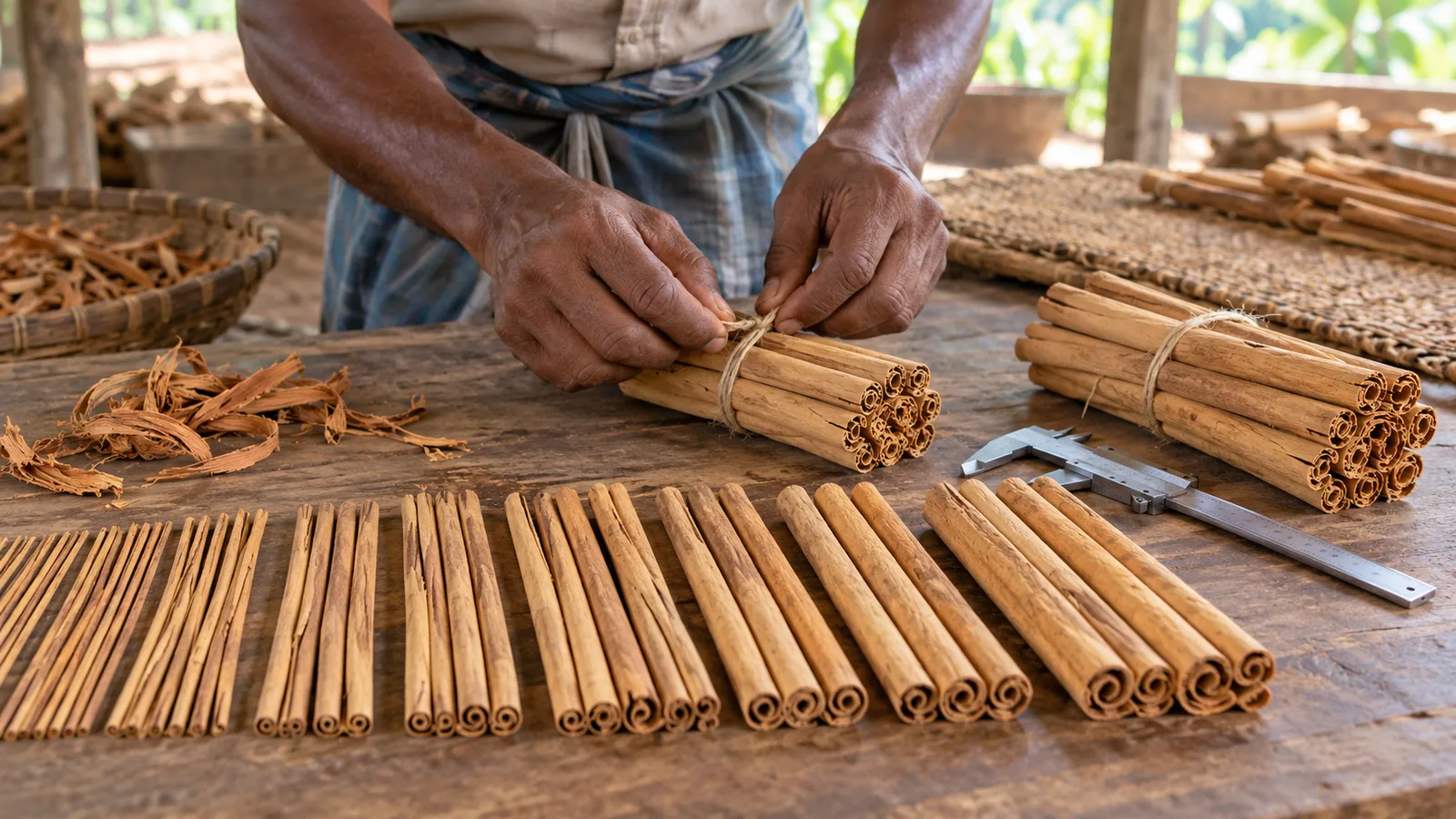
Ceylon cinnamon grades answer one question before any other: how thick may the quill be. The Export Development Board says Ceylon cinnamon is categorised into four major grades, Alba, Continental, Mexican and Hamburg, based on the diameter of the quill. The Department of Export Agriculture's quill grade table then gives each grade code a maximum diameter, from 6 mm for Alba to 38 mm for H3. Your decision as a buyer is which code fits your pack, and this guide sets out the official figures in the official zero notation so that you can write the code into an enquiry.
What a quill grade measures
A cinnamon quill is peeled bark rolled and joined into a pipe-like structure of the required length. The Department of Export Agriculture says quill-making is unique to Sri Lanka, and it gives the botanical name of the plant as Cinnamomum zeylanicum Blume.
The grades in this guide apply to quills. Other pieces of bark are sold as chips, quillings or featherings, so if you are sourcing from the Ceylon cinnamon category, first settle whether you need quills at all.
Oil content, origin marks and certificates are not part of a grade code. They are separate lines in your specification, covered further down.
Pepper, cloves, cardamom, nutmeg and mace are graded on other measures than diameter. Their names are in the guide to official grade names for Sri Lankan spices beyond cinnamon.
The official grade table
The table below takes two columns from the quill grade table on the Department of Export Agriculture cinnamon page: the maximum diameter of the quill, and the minimum number of quills, each 42 inches long, in one kilogram.
| Grade group | Grade code | Maximum quill diameter | Minimum quills per kg (42-inch quills) |
|---|---|---|---|
| Alba | Alba | 6 mm | 45, with no rough quills |
| Continental | C00000 Special | 6 mm | 35 |
| Continental | C00000 | 10 mm | 31 |
| Continental | C0000 | 13 mm | 24 |
| Continental | C000 | 16 mm | 22 |
| Continental | C00 | 17 mm | 20 |
| Continental | C0 | 19 mm | 18 |
| Mexican | M00000 Special | 16 mm | Ask the supplier |
| Mexican | M00000 | 16 mm | Ask the supplier |
| Mexican | M0000 | 19 mm | Ask the supplier |
| Hamburg | H1 | 23 mm | Ask the supplier |
| Hamburg | H2 | 25 mm | Ask the supplier |
| Hamburg | H3 | 38 mm | Ask the supplier |
This guide gives the minimum count for Alba and the Continental grades only. For a Mexican or Hamburg grade, have the count per kg written on the offer.
How to read the codes
The diameter is a ceiling. A C0000 quill may measure anything up to 13 mm. Above that limit it is out of grade.
The count is a floor. Alba needs at least 45 quills of 42 inches to make a kilogram, while C0 needs at least 18. More quills per kg means each quill weighs less, so the count is a second check on the same quill, done with a scale instead of a caliper.
In the Continental group, more zeros mean a lower maximum diameter. C00000 has a maximum of 10 mm and C0 a maximum of 19 mm, with C0000, C000 and C00 between them at 13 mm, 16 mm and 17 mm.
A 6 mm quill is not automatically Alba. Alba and C00000 Special share the same 6 mm maximum. The table gives them different minimum counts, 45 quills per kg against 35, and it states no rough quills for Alba. The Export Development Board describes Alba as the most expensive of the four major grades, so read this line twice on a quotation.
The letter matters as much as the millimetres. C000, M00000 Special and M00000 all have a 16 mm maximum, and C0 and M0000 both have 19 mm. A diameter on its own does not identify a grade. If an offer names a Mexican grade, ask the supplier to state in writing what separates it from the Continental grade of the same diameter.
Hamburg covers the widest quills in this guide. H1 has a maximum of 23 mm and H2 of 25 mm, then the limit moves to 38 mm for H3.
Write the codes with their zeros, as the Department does. If a price list uses a shorthand that is not in the official table, ask for the zero notation with the maximum diameter beside it.
Choosing a grade for your pack
The official table does not say which grade suits which use. That is your commercial choice, and three questions help.
- Will your customer see the whole quill? Decide the widest quill your pack and your customer accept, then choose the code whose maximum sits at or below it.
- Will the quills be cut? The counts in the table refer to 42-inch quills. If you want shorter pieces, give the cut length and ask how the supplier confirms the grade before cutting.
- Will the cinnamon be ground or extracted? Then nobody sees the quill, so ask whether a quill grade is what you need.
The Export Development Board publishes Sri Lanka's export tariff lines for cinnamon under heading H.09.06. Quills have their own national line, and so do quillings (H.09.06.11.93), featherings (H.09.06.11.94), chips (H.09.06.11.95), crushed cinnamon (H.09.06.20.10) and ground cinnamon (H.09.06.20.20), as shown in the Export Development Board list of HS codes for export spices. The Department of Commerce explains that all countries agree on the first six digits of an HS code, while national tariff lines can differ, so confirm your own import code with your customs broker.
What the grade code does not tell you
Oil content. The Department of Export Agriculture gives the volatile oil standard for cinnamon as 1% for quills and 0.7% for other cinnamon products. The figure is set for quills as a product, not for one grade letter, so ask for it on a test report.
The standard behind the specification. ISO 6539:2014 specifies requirements for whole or ground cinnamon of the Sri Lankan, Madagascan and Seychelles types, and requirements for cassia are in ISO 6538. The Export Development Board's guidelines for its "Pure Ceylon Cinnamon" logo refer to SLS 81 for hygiene, grading, packaging and labelling. This guide quotes no limits from these standards: name the one you buy against and ask for the test report.
Third-party checks. The Sri Lanka Standards Institution runs a Pre-Export Certification for Cinnamon, to ensure that exported cinnamon conforms to the Sri Lanka Standard or the buyer's specification. It is described on the Sri Lanka Standards Institution quality assurance page.
Origin marks. A grade code is not an origin mark. Commission Implementing Regulation (EU) 2022/144 registered the name "Ceylon cinnamon" as a Protected Geographical Indication (PGI) in the European Union, and the Export Development Board says anyone who uses the PGI mark must be a member of the Association for Ceylon Cinnamon Protected Geographical Indication. If the mark matters for your pack, ask the supplier for evidence of that membership.
Whether the bark is cassia. The Export Development Board describes Ceylon cinnamon as light brown, folded in several layers like a cigar, soft, fragile and easy to break, and cassia as reddish dark brown with one inward fold and an empty cavity, hard and difficult to break. Hold your sample against that description when it arrives.
How to specify a grade in an enquiry
- Name the product form and the plant. Write "Ceylon cinnamon quills" and the botanical name Cinnamomum zeylanicum Blume, so that chips, quillings and featherings are not part of the offer.
- Give the grade code in the official notation. Put the maximum diameter beside it, for example "C0000, maximum 13 mm", so that a typing slip in the zeros is caught by the millimetres.
- State the count or the cut. For full-length quills, give the minimum number of 42-inch quills per kg. For cut quills, give the length you want.
- Add the test figures. Ask for the volatile oil result against the Department's 1% standard for quills, and add any limits your own market sets. Destination rules change, so confirm them with your customs broker first.
- List the certificates you want. The Export Development Board's export procedure guide says a quality certificate, a phytosanitary certificate (the plant health certificate), a fumigation certificate and other test reports should be submitted when the buyer requests them. Sri Lanka's National Plant Quarantine Service issues the phytosanitary certificate before dispatch, after its officers inspect and sample the goods.
- Ask for a sample and measure it. The guide says trade samples are usually sent by airmail. Agree how the diameter is measured and how many quills are sampled, check the sample against the code, and use the same check on delivery.
- Send everything in one message. Add the quantity, pack type and destination port, and send the enquiry through the quote request page.
Common mistakes
- Ordering "cinnamon sticks" with no grade code. The supplier has to guess between a 6 mm quill and a 38 mm quill, and quotes built on different guesses cannot be compared.
- Naming the group without the code. "Continental" alone runs from a 6 mm maximum to a 19 mm maximum.
- Giving a diameter without the letter. A 16 mm maximum fits C000, M00000 Special and M00000.
- Treating every 6 mm quill as Alba. C00000 Special has the same maximum diameter and a lower minimum count.
- Assuming the grade covers oil content, origin marks or certificates. Each of these is a separate request.
Frequently asked questions
What are the four grades of Ceylon cinnamon?
The Export Development Board names four major grades, Alba, Continental, Mexican and Hamburg, based on the diameter of the quill. The Department of Export Agriculture's table divides the last three into individual codes such as C0000, M0000 and H1.
What is the maximum diameter of an Alba cinnamon quill?
In the Department of Export Agriculture's quill grade table, Alba has a maximum diameter of 6 mm, a minimum of 45 quills of 42 inches per kg and no rough quills. A quill at that diameter is not Alba unless it also meets the count.
How is Alba different from C00000 Special?
Both have a maximum diameter of 6 mm. The table gives Alba a minimum of 45 quills per kg and no rough quills, and C00000 Special a minimum of 35 quills per kg.
What do H1, H2 and H3 mean in cinnamon grades?
They are the Hamburg grades in the Department of Export Agriculture's table. H1 has a maximum quill diameter of 23 mm, H2 of 25 mm and H3 of 38 mm, so an order should name the number as well as the word Hamburg.
Does the grade tell you the oil content of the cinnamon?
No. The grade code describes the size of the quill. The Department of Export Agriculture gives a separate volatile oil standard of 1% for quills and 0.7% for other cinnamon products, so ask for the result on a test report.
If you already know the code, the diameter and the pack you want, put them in one message with your quantity and destination port and request a quote through the Truly Ceylon How to order page. There is no need to choose from a list of grades: send the specification you buy against. Other product lines are in the Sri Lankan spices category, and general buyer questions are covered on the Truly Ceylon FAQ page.
Key takeaways
- Ceylon cinnamon has four major grades by quill diameter: Alba, Continental, Mexican and Hamburg, with maximums from 6 mm to 38 mm across the individual codes.
- The diameter is a maximum and the count per kg is a minimum. Put both in the specification.
- Alba and C00000 Special share a 6 mm maximum, and several Continental and Mexican codes share 16 mm or 19 mm, so write the full code with its zeros.
- A grade code says nothing about oil content, origin marks or certificates. Ask for each one separately.
Sourcing from Sri Lanka?
Send us the product, quantity, packing and destination port for a written quotation.