Certificate of origin Sri Lanka: Department of Commerce or chamber, which one earns a duty preference?
Truly Ceylon export team ·
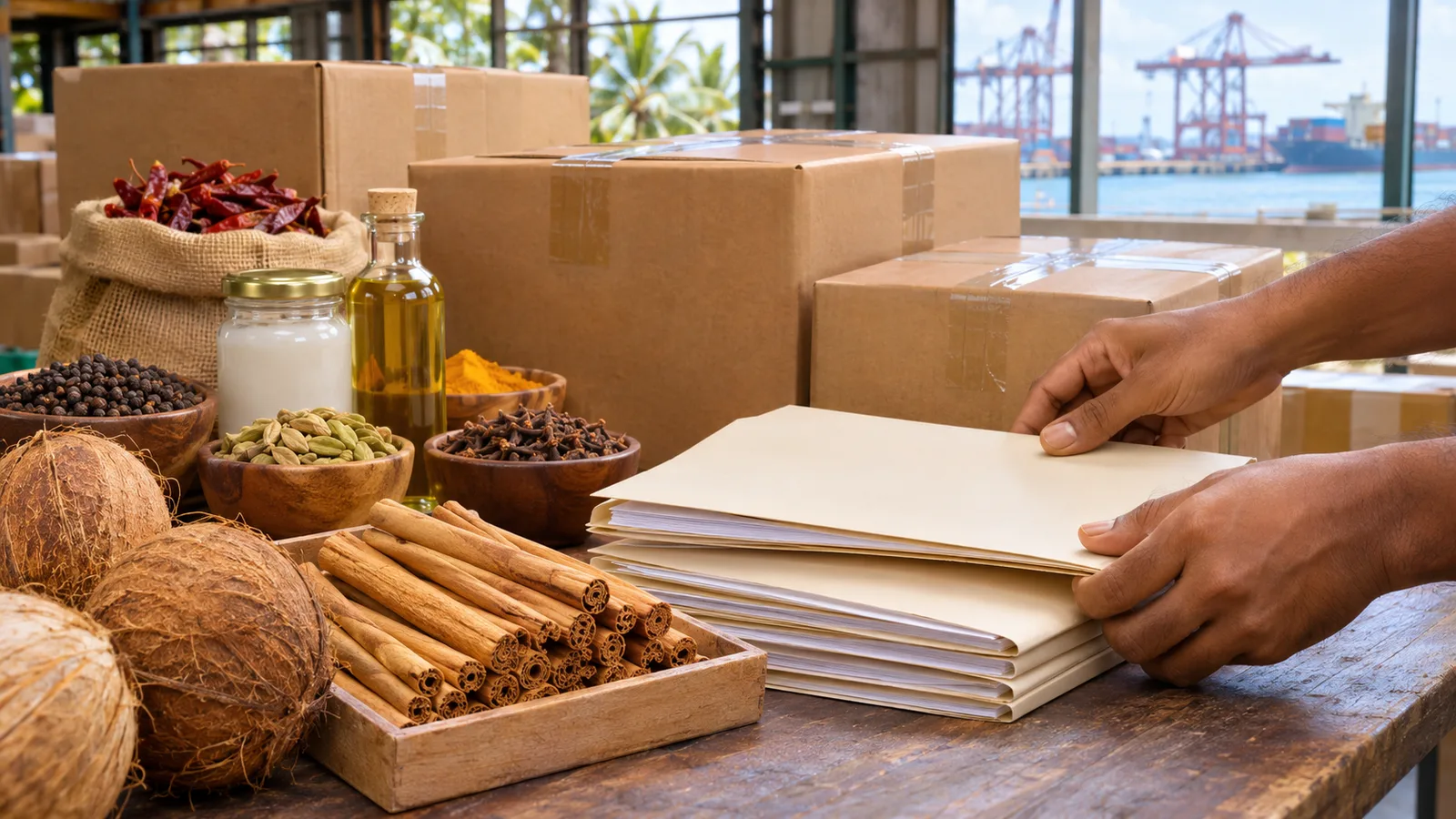
A certificate of origin from Sri Lanka comes from one of two kinds of issuer, and only one kind can support a duty preference. The Department of Commerce issues preferential certificates under trade agreements and GSP schemes, while chambers of commerce issue ordinary certificates that state origin but do not claim a tariff concession. Before you order, decide which one your customs office will ask for, because the exporter cannot fix the wrong paper after the goods have sailed.
Two issuers, two purposes
The Export Development Board's export procedure guide (2020) says the Department of Commerce issues certificates of origin under all GSP schemes, free trade agreements and multilateral trading agreements. Ordinary certificates of origin are issued by chambers such as the Ceylon Chamber of Commerce or the National Chamber of Commerce.
In practice, an ordinary certificate answers one question: where were the goods produced. A preferential certificate answers a second one: do the goods qualify for the reduced or zero duty that an agreement grants. Your customs broker needs the second answer when the duty rate on your invoice depends on it.
| Question | Preferential certificate | Ordinary certificate |
|---|---|---|
| Who issues it | Department of Commerce | A chamber such as the Ceylon Chamber of Commerce or the National Chamber of Commerce |
| What it supports | A claim under a GSP scheme, free trade agreement or multilateral agreement | A statement of origin for the buyer, bank or customs file |
| Exporter registration | One-time registration with the Department of Commerce | Set by the chamber that issues it |
| When to ask for it | When your destination grants a concession for the product | When the buyer, bank or letter of credit asks for origin only |
Which agreements the Department of Commerce covers
The Department of Commerce handbook for exporters lists the agreements it issues certificates for: the India-Sri Lanka and Pakistan-Sri Lanka free trade agreements, SAFTA, SAPTA, the Asia Pacific Trade Agreement and the GSTP. It also lists the GSP schemes of the EU, Norway, Switzerland, Turkey, Australia, Canada, New Zealand, the Eurasian Economic Union, Japan, the USA and the UK.
If you search for an ISFTA certificate of origin, this is the document you mean. The India-Sri Lanka Free Trade Agreement entered into force in 2000, and the Department of Commerce lists it, with the Pakistan-Sri Lanka agreement in force since 2005, among the free trade agreements in operation. A preference for India is therefore claimed with a Department of Commerce certificate, not with a chamber certificate.
Where REX replaces the certificate
For exports to the EU, Norway, Switzerland and Turkey, the Department of Commerce handbook says its certificate of origin no longer applies. Under the Registered Exporter (REX) system the exporter makes a Statement on Origin on the invoice or another commercial document, using a registration number in the format LKREX followed by the exporter's number.
This matters when you read an old specification or a template contract that asks for a Form A or a GSP certificate for a European destination. For an EU order, ask instead for the REX statement and the LKREX number, and have your broker confirm that wording against the current EU rules. Our guide to importing spices into the EU from Sri Lanka sets the origin statement beside the phytosanitary certificate and the residue test.
Check whether a preference exists before you order
A certificate only helps if the product actually has a concession in your market. The EU's Access2Markets portal lists Sri Lanka among the eight GSP+ beneficiary countries, for which the EU cuts import duties to zero on more than two thirds of tariff lines, and says the current GSP+ is valid until 2027. The UK lists Sri Lanka under Enhanced Preferences in its Developing Countries Trading Scheme, which entitles exporters in eligible countries to 0% import tariffs on 92% of their product lines.
Those are shares of tariff lines, not promises about your product. Your cinnamon, pepper or coconut oil may sit in a line that is covered, or in one that is not, and the answer depends on the HS code. The Department of Commerce says exporters can ask it by email whether a product is eligible for tariff concessions by giving the HS code, product description and destination country, and can make a preliminary check with the International Trade Centre's Market Access Map. A buyer can run the same check from the import side with the destination's own tariff tool.
- Agree the HS code with your customs broker before the enquiry, not after the invoice.
- Look the code up for your destination in the tariff tool of that country or in the Market Access Map, and note whether a preference is listed for Sri Lanka.
- Put the result into the enquiry: preferential certificate, REX statement or ordinary certificate of origin.
- Ask the exporter which issuer will supply it and whether it is registered for that scheme.
- Agree in the contract who sends the original and when, so that it can reach the bank or the broker with the other shipping documents.
The paper then travels with the rest of the set. The EDB guide lists the documents submitted to the bank as the commercial invoice, the original bill of lading or airway bill, the insurance policy if on CIF, the bill of exchange if on D/P or D/A terms, the letter of credit, the certificate of origin or GSP certificate, and the packing list. Our export documents checklist shows which of those come as standard and which you must request.
What the exporter has to do first
To apply for preferential certificates an exporter must first register once with the Department of Commerce and receive a registration number in the form D/COM/R/XXXXXX. A fee is charged for that registration; the amount is on the Department's handbook, so check it there rather than in a quotation. An exporter that has not registered cannot issue a preferential certificate, so ask for the registration number in your enquiry. Our guide to verifying a Sri Lankan exporter before you pay explains which other registrations prove what.
Spices get extra attention. The Department of Commerce asks exporters of spices and allied products, including areca nut and pepper, for additional documents at registration, such as a supplier list, warehouse details and an auditor's report. A pepper or spice supplier that has been through that process has had its supply chain looked at by the issuing body, which is useful to know, but it does not replace the grade and test report you would ask for anyway. See the spices wholesale guide for the grade names to put on the offer.
Common mistakes
- Asking for a GSP certificate for an EU order when the exporter should make a REX statement with an LKREX number.
- Accepting a chamber certificate and expecting it to carry a duty preference.
- Choosing the certificate type after the goods are packed, when the HS code was never agreed.
- Not asking whether the exporter is registered with the Department of Commerce.
- Treating the share of tariff lines covered by GSP+ or the UK scheme as proof that your product is covered.
- Leaving the originals out of the courier plan, so the bank or broker waits for them.
Frequently asked questions
Who issues a certificate of origin in Sri Lanka?
The Department of Commerce issues certificates under GSP schemes, free trade agreements and multilateral agreements, and chambers such as the Ceylon Chamber of Commerce or the National Chamber of Commerce issue ordinary certificates. Which one you need depends on whether you are claiming a preference.
Is a chamber certificate enough for a duty preference?
No. The EDB guide places certificates under trade agreements and GSP schemes with the Department of Commerce, and ordinary certificates with the chambers. Ask your broker which document your customs office accepts for the preference you want.
Do I need a certificate of origin for the EU?
For the EU, Norway, Switzerland and Turkey the Department of Commerce certificate no longer applies. The exporter makes a Statement on Origin on the invoice or another commercial document, using its LKREX registration number. Confirm the current wording with your customs broker.
How do I find out if my product has a preference?
Give your broker the HS code and destination, and check the destination's tariff tool or the International Trade Centre's Market Access Map. The Department of Commerce also answers eligibility questions by email when you send the HS code, product description and destination country.
Does a certificate of origin replace a phytosanitary certificate?
No. Origin and plant health are separate questions answered by different bodies. The National Plant Quarantine Service issues the phytosanitary certificate after inspection, so list both papers in the enquiry if your product needs them.
Ask for the right paper in your quote request
If you are comparing offers across spices and coconut products, say in your enquiry which origin document your destination needs and give the HS code. You can send those details through the quote request steps, and confirm the final requirements with your own customs broker. For a wider view of the paperwork, read importing from Sri Lanka for the first time. Official pages: the EDB export procedure guide, the EU GSP+ page and the UK trading scheme tiers.
Key takeaways
- The Department of Commerce issues preferential certificates; chambers issue ordinary ones.
- For the EU, Norway, Switzerland and Turkey, ask for a REX Statement on Origin with an LKREX number.
- Check the HS code against the destination's tariff tool before you order.
- Ask whether the exporter is registered with the Department of Commerce.
- Origin and phytosanitary certificates are separate papers.
Sourcing from Sri Lanka?
Send us the product, quantity, packing and destination port for a written quotation.