Dehydrated mango bulk supplier in Sri Lanka: which answers belong in writing before the first order?
Truly Ceylon export team ·
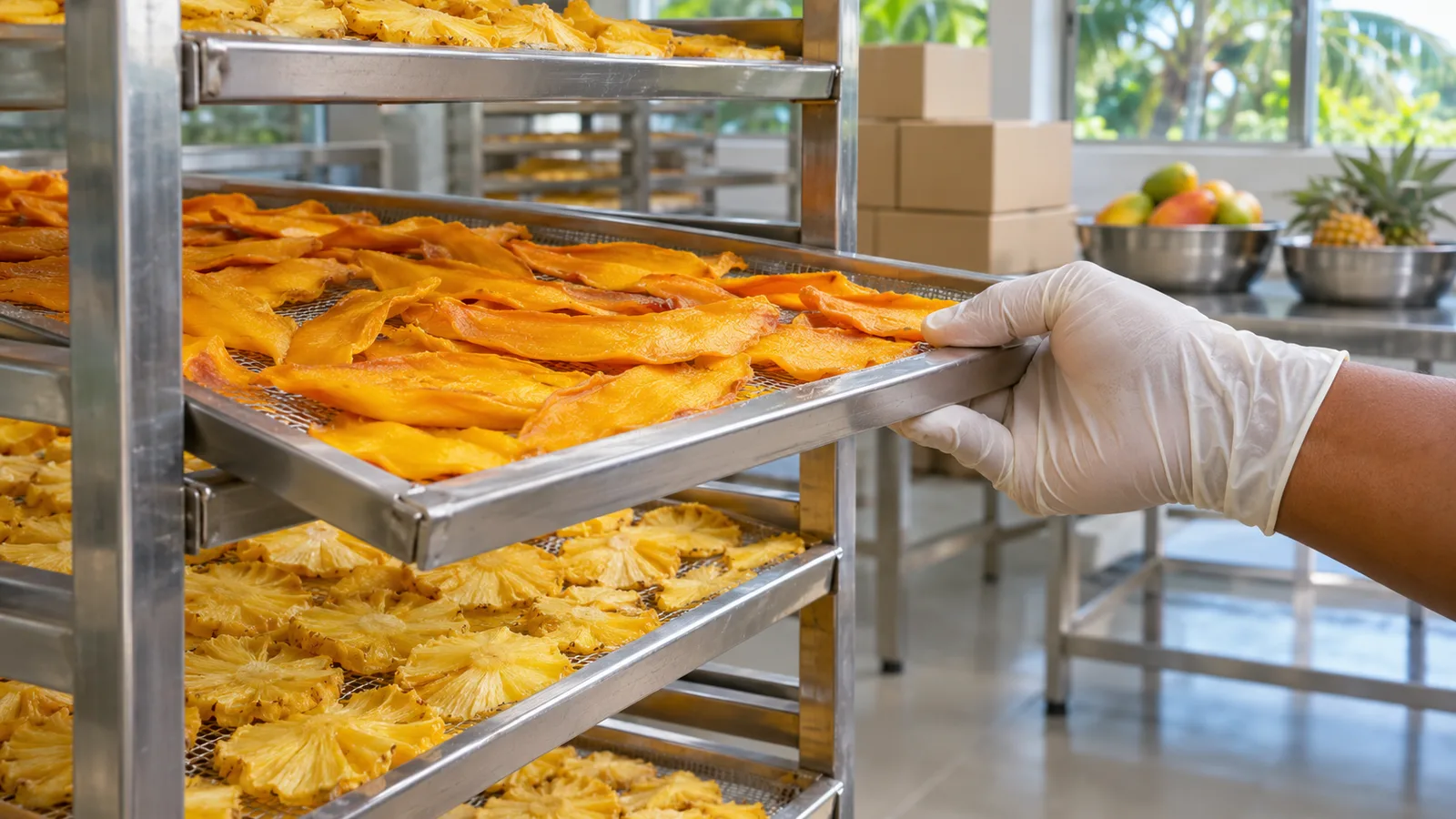
A dehydrated mango bulk supplier in Sri Lanka can only be compared fairly once you have written down the cut, the added ingredients and the lab reports your factory needs. The Export Development Board (EDB) says dehydrated pineapple, mango and papaya are among the popular varieties Sri Lanka produces and exports to the UK, USA, Australia, Spain and the Maldives. This guide is for the food manufacturer who will put the fruit into a cereal, a mix or a dessert, and it gives the list of questions that belongs in the quote request.
Where dried mango and pineapple already go
The EDB's page on processed fruit and vegetables says suppliers in Sri Lanka offer fruit in pieces, pulp, juice, preserves and dehydrated form, and that pineapple, mango, papaya, melons and guavas are the fruits processed most. One fruit therefore reaches you in several forms, and "dried mango" on its own does not tell a supplier what to quote.
For manufacturers, the EDB's 2021 food and beverage sector report names three advantages of dehydration: handling, transportation and being "ready to use". It says dehydrated fruit is used as a tropical fruit dessert supplement and in instant soup and rice mixes. Your recipe decides whether you need slices, pieces, pulp or a mixed-fruit blend.
Truly Ceylon's food and beverages category lists dehydrated mango, mango pulp, pineapple, soursop, banana chips and mixed fruit. Open the pages for dehydrated mango, dehydrated pineapple and dehydrated mixed fruit to see what each record states and what it leaves for the specification sheet.
Why a manufacturer asks different questions from a retailer
A retailer sells the pack as it arrives. A manufacturer changes the fruit, so a detail that looks small, such as the amount of added sugar or the cut size, moves through your whole recipe, your label and your ingredient declarations. Our guide to dehydrated fruit suppliers in Sri Lanka covers the general papers. The list below is narrower: it is what an ingredient buyer should settle for mango and pineapple before comparing quotes.
The question list for your quote request
Put the answers in the supplier's specification sheet or the written quotation, not in a chat message. The table pairs each question with the reason a factory needs the answer.
| Ask about | What to request in writing | Why your factory needs it |
|---|---|---|
| Form and cut | Slices, dices, strips, pieces, pulp or powder, with the size range and the breakage tolerated | Decides how the fruit mixes, flows through your line and looks in the finished pack |
| Added ingredients | Sugar, any preservative, oil, flavouring or colouring, or a statement that nothing is added | Feeds your ingredient list and label in the destination market |
| Moisture | The limit the supplier works to, the test method and whether water activity is also measured | Affects texture, clumping and how long your own product keeps |
| Variety and origin | The fruit variety and the district where it was grown | Taste and colour can differ between varieties and seasons |
| Residues and contaminants | Which tests run on every lot, which laboratory signs them and which market's limits apply | Your import authority may test the lot again on arrival |
| Shelf life and storage | The stated shelf life and the storage conditions it assumes | Sets how much stock you can hold between deliveries |
| Packing and lot coding | Inner bag material, net weight per bag, carton type and how each lot is coded | Lets you trace a problem back to one production lot |
The EDB's sector report of 2021 states that the majority of Sri Lankan processed food exporters have obtained ISO 22000, HACCP, BRC, Kosher or organic certificates. That is a statement about the sector, not about one supplier, so ask each supplier which certificates it holds and ask for the copies. If you need organic fruit, the EDB's export procedure guide says organic exports need a certificate from an accredited certification body and registration with the National Organic Control Unit at the EDB.
The specification sheet states what the supplier undertakes to deliver, and the certificate of analysis shows what one lot measured. Our questions to ask a food supplier before ordering cover the factory, packaging and label questions that sit around this list.
What the health certificate and the lab report cover
The Food Control Administration Unit (FCAU) of Sri Lanka's Ministry of Health issues health certificates for exported food, and only to establishments registered with it. A factory inspection is a pre-requisite, and the FCAU may refuse certificates for food from factories that do not comply with the food hygiene regulations.
For each consignment the FCAU asks for an application form, a sample of the product, analysis reports and other relevant documents, and it usually tests a sample at a laboratory it recognises. It also says different countries request different parameters in the health certificate and advises exporters to check them with the importing agent before exporting. For a manufacturer that means one thing: tell the supplier which parameters your authority expects before the goods are packed. The FCAU does not certify fresh vegetables and fruits, which the Plant Quarantine Unit of the Department of Agriculture certifies, so ask which route your product form takes.
What your destination asks of you as the buyer
When you buy an ingredient for your own plant you are often the importer, and some rules fall on you rather than on the supplier. The table shows what the official pages say for five markets. Rules are amended often, so confirm them with your customs broker or the authority before you order.
| Destination | What the official page says | What to ask the supplier for |
|---|---|---|
| European Union | Maximum residue levels under Regulation EC 396/2005 apply to 315 fresh products and the same products after processing, with a default level of 0.01 mg/kg where a pesticide is not specifically mentioned | A residue report that states the limits it was tested against |
| United States | The importer, meaning the US owner or consignee, must follow a Foreign Supplier Verification Programs plan for each food, and prior notice must be given to the FDA for imported food | Food safety records, audit reports and the facility details your hazard analysis needs |
| Canada | A licence is required to import food, including food ingredients, and importers must keep traceability records accessible in Canada for two years | Records that show how the fruit was made, packed and labelled |
| Australia | The BICON system tells an importer whether a commodity is permitted or needs a permit, and food must also meet Australia's food standards | Documents your broker can match against the BICON entry |
| Japan | Under the Food Sanitation Act an import notification must be submitted on each occasion food is imported for business use | Product details to complete the notification |
The European Commission's residue page and the FDA's FSVP rule page are the pages to read first for those two markets. Our guides to importing food from Sri Lanka to the USA and to how the rules differ by destination go further.
How to send the request, step by step
- Write the end use first: cereal inclusion, soup or rice mix, dessert or snack, and the form you want.
- List the product, the quantity, whether it is a one-off or repeat order, the pack size, the destination port and the Incoterm you prefer.
- Add the table's questions as numbered lines, so each answer comes back against a number.
- State the documents and test reports your market requires, as the How to order page asks you to.
- Ask for samples and the specification sheet with the quotation, then agree the specification and labelling before you confirm the order.
Check who you are dealing with at the same time. Our guide to verifying a Sri Lankan exporter shows which registrations prove what.
Common mistakes
Asking for "dried mango" only. Without the form and cut, two quotes describe two different products.
Leaving added ingredients out of the question. The label of your finished product depends on them.
Accepting a lab report from another lot. A certificate of analysis describes the lot on its date and lot number, not the lot you buy.
Assuming the supplier handles the import side. For a manufacturer buying directly, the importer's duties can be yours.
Treating a sector statement as a supplier's certificate. That most exporters hold certificates says nothing about the one you pick.
Frequently asked questions
Which Sri Lankan authority issues the health certificate for dehydrated fruit?
The Food Control Administration Unit (FCAU) of the Ministry of Health issues health certificates for exported processed food, and only to establishments registered with it. Fresh fruit is certified separately by the Plant Quarantine Unit of the Department of Agriculture, so ask which one applies to your product form.
Does a dehydrated mango supplier have to give me a pesticide residue report?
The FCAU asks for analysis reports and usually tests a sample from each consignment, but the parameters differ by importing country. Name your market in the request and ask which residue limits the report is tested against, then confirm the limits with your own authority.
Is dehydrated pineapple treated the same as fresh pineapple at the border?
Not necessarily. The European Commission lists pineapples among five fruits that need no phytosanitary certificate, but that statement concerns the fruit it names. Ask your customs broker how your dried product and its HS code are treated before you rely on it.
What is the difference between a specification sheet and a certificate of analysis?
The specification sheet states what the supplier undertakes to deliver in general, such as cut, packing and limits. The certificate of analysis is a laboratory report on one production lot, so check its date and lot number against the goods you are buying.
Who is the importer when a US food manufacturer buys dried fruit directly?
Under the FDA's Foreign Supplier Verification Programs rule, the importer is the US owner or consignee of the food, so a manufacturer buying directly usually carries that duty. Ask the supplier for the records your hazard analysis needs, and confirm the details with the FDA page.
When your list is ready, send it by email as the How to order page describes, and the export team replies with a written quotation for your quantity and destination.
Key takeaways
- Name the form, cut and end use before you ask any supplier to quote.
- Get added ingredients, moisture and shelf life in the specification sheet.
- Match each certificate of analysis to a lot date and number.
- Tell the supplier your market's parameters before the health certificate is requested.
- As the importer you may carry your market's duties, so confirm them with your broker.
Sourcing from Sri Lanka?
Send us the product, quantity, packing and destination port for a written quotation.