Dehydrated fruit suppliers in Sri Lanka: which specs, reports and certificates should you ask for?
Truly Ceylon export team ·
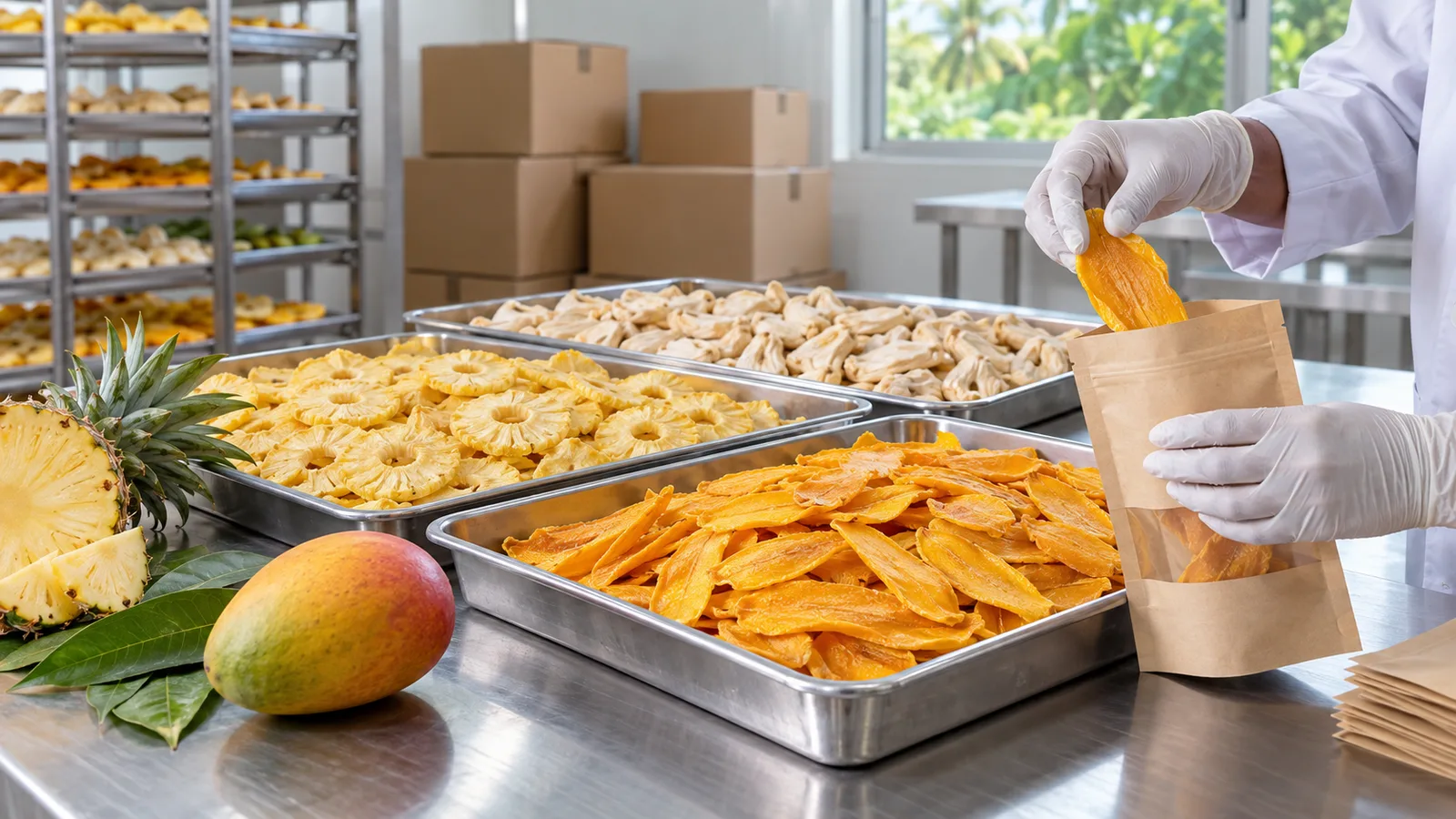
Choosing between dehydrated fruit suppliers in Sri Lanka comes down to three decisions you make before any price is compared: the exact product and cut, the specification your own market will accept, and the certificates that must travel with the goods. Sri Lanka's Export Development Board (EDB) says dehydrated pineapple, mango and papaya are among the popular varieties produced in the country, exported to the UK, USA, Australia, Spain and the Maldives. This guide gives no moisture, cut-size or shelf-life figures. Those belong on each supplier's specification sheet and laboratory report.
What Sri Lanka dehydrates and where it already sells
The EDB's page on processed fruit and vegetables says processed fruit suppliers in Sri Lanka offer fruit in pieces, pulp, juice, preserves and dehydrated form, and it names pineapple, mango, papaya, melons and guavas as the fruits processed most. One fruit can reach you in several forms, so the word "dehydrated" has to sit in the enquiry next to the cut.
The same page says Sri Lanka exports processed local vegetables such as okra, drumsticks, manioc and young jack, mainly for ethnic communities in Europe, the Middle East, Australia and New Zealand. Elsewhere the EDB says the country exports the fruit and pods of perennial crops such as breadfruit, young jackfruit and murunga (drumstick).
On this site the dried lines sit in the food and beverages category. They include dehydrated mango, dehydrated pineapple, dehydrated young jackfruit and dehydrated breadfruit, with soursop and banana chips listed beside them. For each one the specification is the supplier's own document, so ask for it instead of relying on a general description.
How buyers use dehydrated fruit and vegetables
The EDB's food and beverage sector report of 2021 gives handling, transportation and being "ready to use" as the advantages of dehydration. It says dehydrated fruit is used as a tropical fruit dessert supplement and in instant soup and rice mixes, and that value added baby jackfruit and banana blossom leave Sri Lanka in different forms to be used as substitutes for meat and fish products.
Your end use decides the specification. A retail snack pack, an ingredient for a cereal or soup blender and a food-service pack of young jackfruit call for different cuts, packing and test limits, so state the end use in the first message.
The specification sheet: what to ask before you compare quotes
Two documents carry the technical facts. The specification sheet, or spec sheet, states what the supplier undertakes to deliver. The certificate of analysis (COA) is a laboratory report showing what one production lot measured. Ask for both, and put these questions wherever the papers leave a gap.
- Raw material. Which fruit or vegetable, which variety if that matters to your customer, and where it was grown.
- Cut and size. Slices, dices, strips, chips or powder, with the size range and the breakage tolerated.
- What is added. Sugar, a preservative such as sulphur dioxide, oil, flavouring or colouring. Each answer changes your label.
- Moisture. The limit the supplier works to, the test method, and whether water activity is measured as well.
- Microbiology and contaminants. Which tests run on every lot and which laboratory signs the report.
- Pesticide residues. Which market's limits the lot is tested against.
- Shelf life and storage. The stated shelf life and the storage conditions it assumes.
- Packing. Inner bag material, net weight per bag, carton type and lot coding.
Read the date and the lot number on any COA you are shown. A report from an earlier season describes that lot, not yours.
Test reports are only one part of the checking. Our list of questions to ask a food supplier before ordering covers the factory registration, packaging, label and document questions to settle before a first order.
The documents and who issues each one
The table is drawn from the issuing bodies' own pages and from the export procedure guide the EDB published in 2020.
| Document | Issued by | Point to confirm |
|---|---|---|
| Health certificate for exported food | Food Control Administration Unit (FCAU), Ministry of Health | The parameters your country wants stated on it |
| Phytosanitary certificate (the official plant health certificate) | National Plant Quarantine Service | Whether your market asks for one for this dried product |
| Quality certificate | Accredited quality firms such as SLSI, ITI and SGS Lanka | The standard or buyer specification the lot was tested against |
| Certificate of origin | The Department of Commerce for preference schemes and trade agreements; a chamber of commerce for an ordinary certificate. For the EU, the exporter makes a statement on origin under the Registered Exporter (REX) system instead | The type your customs authority accepts |
| Organic certificate | An accredited certification body, for example under EU, USDA-NOP or JAS rules | Scope, validity date and the product named on it |
The Food Control Administration Unit of the Ministry of Health issues health certificates for exported food, and only to establishments registered with it. A factory inspection is a pre-requisite. Processed foods are within its scope. Fresh vegetables and fruits are not: the Plant Quarantine Unit of the Department of Agriculture certifies those.
For each consignment the FCAU asks for a completed application form, a sample of the product, analysis reports and other relevant documents, and it usually tests a sample from the consignment at a laboratory it recognises before it issues the certificate. It also says different countries request different parameters in the health certificate, and advises exporters to check the requirements with the importing agent before exporting. That importing agent is you or your broker, so send the parameters with the enquiry.
None of these papers arrives by default. The EDB guide names the quality certificate, the health certificate, the phytosanitary certificate, the fumigation certificate, HACCP certification for food items and other test reports as papers the exporter submits when the buyer requests them.
Food safety system certificates need the same care. The EDB's sector report says the majority of Sri Lankan processed food exporters have obtained ISO 22000, HACCP, BRC, Kosher or organic certificates. That describes the sector, not any one supplier. Ask each supplier for a copy, then read the certification body, the scope and the expiry date. For organic lots the EDB guide adds compulsory registration with the National Organic Control Unit at the EDB.
What your own market checks at the border
Each importing country sets its own rules. The table gives the starting point each authority publishes.
| Market | What the authority says | What to do with it |
|---|---|---|
| European Union | Maximum residue levels (MRLs) for pesticides are set under Regulation EC 396/2005. They apply to 315 fresh products and to the same products after processing, with a general default MRL of 0.01 mg/kg where a pesticide is not specifically mentioned. | Ask for a pesticide residue report on your lot and state that EU limits apply |
| United States | The FDA says food can be imported without prior FDA sanction as long as the facilities that produce, store or handle it are registered with the FDA and prior notice of incoming shipments is provided. | Ask whether the facility is registered and agree who files the prior notice |
| Great Britain | Plants and plant products from non-EU countries are categorised as high risk, medium risk A, medium risk B or low risk, and low risk goods are exempt from plant health controls. | Have your broker confirm the category of the dried product |
| Australia | The Biosecurity Import Conditions system (BICON) tells an importer whether a commodity is permitted, is subject to import conditions, requires supporting documentation or treatment, or needs an import permit. | Look the product up and send the supplier any document it lists |
The European Commission's page on EU legislation on MRLs sets out the residue rules above. On plant health, plants and plant products listed in Annexes XI and XII of Regulation (EU) 2019/2072 must enter the EU with a phytosanitary certificate from the exporting country's national plant protection authorities. Whether your dried product is on those lists is a question for your customs broker.
Rules change, so confirm the current requirement with your customs broker or on the authority's own page before you order.
Six steps from enquiry to a confirmed order
- Define the product. Fruit or vegetable, cut, sweetened or unsweetened, pack type, quantity, destination port and end use.
- List what your market requires. Get the certificates, the health certificate parameters and the residue limits from your broker or the authority's page.
- Send one written enquiry. Put the first two steps into a single message on the how to order page, and ask for the specification sheet and a recent COA with the quote.
- Request a sample. Trade samples usually travel by airmail, and the EDB guide says samples below a value limit stated in the guide can leave Sri Lanka freely with only a customs declaration form.
- Test the sample against the paper. Check cut, colour, taste and moisture in your own laboratory or your customer's, and compare the result with the COA.
- Agree the pro-forma invoice and the contract. The exporter's pro-forma invoice states the product description, quantity, price, terms of payment, terms of delivery and packing and marking details. The EDB guide suggests writing packaging specifications into the contract to avoid disputes. Add the agreed specification and the certificate list as well.
Common mistakes
- Asking for "dried mango" and nothing else. Without the cut, the sweetening and the pack, two quotes cannot be compared.
- Reading a sector statement as a supplier's certificate. A majority of exporters holding a certificate does not show that this one does. Ask for the copy.
- Requesting certificates after packing. The FCAU usually tests a sample before it issues a health certificate, and plant quarantine inspection happens before dispatch.
- Comparing quotes on different delivery terms. Incoterms are the International Chamber of Commerce's three-letter trade terms. Under CFR (Cost and Freight) and CIF (Cost Insurance and Freight) the seller pays the cost and freight to the named port of destination, and under CIF the seller must also procure marine insurance, so a CIF price and an FOB (Free on Board) price are not the same offer.
Frequently asked questions
Which dehydrated fruits does Sri Lanka export?
The Export Development Board says dehydrated pineapple, mango and papaya are among the popular varieties produced in Sri Lanka and exported to the UK, USA, Australia, Spain and the Maldives.
Does dehydrated fruit from Sri Lanka come with a health certificate?
Only when you ask for one. The Food Control Administration Unit of the Ministry of Health issues health certificates for exported processed foods to establishments registered with it, and the exporter submits one when the buyer requests it.
Do I need a phytosanitary certificate for dried fruit?
That depends on your country's plant health rules and on the product. Sri Lanka's National Plant Quarantine Service issues the certificate before dispatch, after its officers inspect and sample the goods, so confirm the requirement with your customs broker before packing.
Where do I find moisture and shelf-life figures for a dehydrated product?
On the supplier's specification sheet and on the certificate of analysis for a production lot. Ask for both with the quote, and check the lot number and the test date.
Once the product, cut, pack, quantity, destination port and certificate list are on one page, send them through the Truly Ceylon quote request page and ask for the specification sheet and a certificate of analysis with the quote.
Key takeaways
- Name the fruit or vegetable, the cut, what is added and the pack before you ask for a price.
- Moisture, shelf life and test limits come from the supplier's specification sheet and a lot-specific COA.
- Health, phytosanitary, quality and origin certificates come from different offices and are supplied when the buyer requests them.
- Confirm destination rules with your customs broker before you order, because they change.
Sourcing from Sri Lanka?
Send us the product, quantity, packing and destination port for a written quotation.