Coconut shell charcoal briquettes or shisha cubes: which product, and which test report, should your enquiry name?
Truly Ceylon export team ·
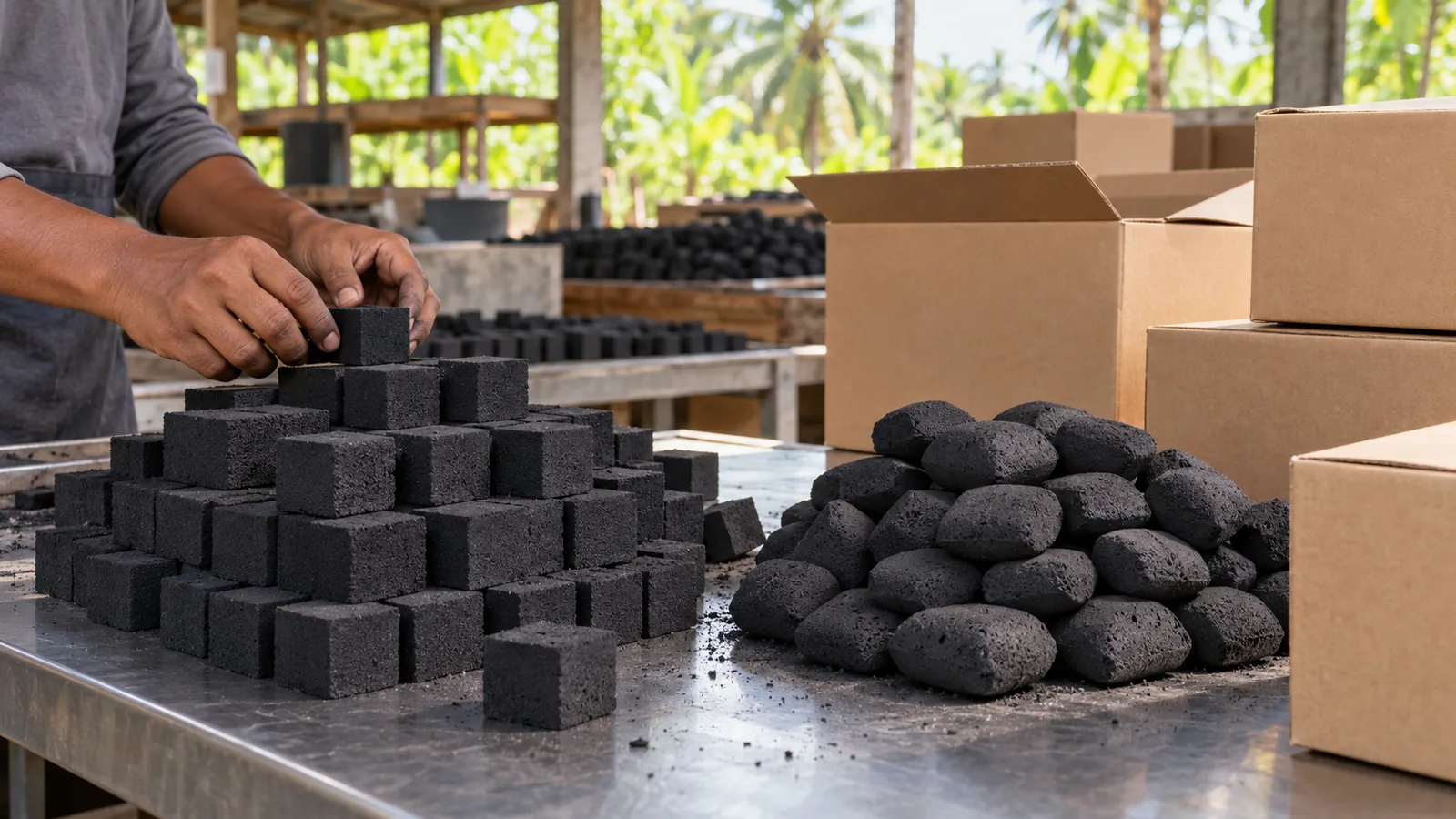
Coconut shell charcoal briquettes and shisha cubes come from the same raw material, but they are two products bought by two different kinds of customer. Briquettes go into barbecues and home heating; cubes go to shisha (hookah) cafés and retailers, a trade the Export Development Board (EDB) links mainly to Middle Eastern markets. Before you ask a Sri Lankan supplier for a price, decide which of the two you are buying, state the size or shape, and ask for the lot's test report: the figures that decide quality, such as ash, moisture and burn time, are not published by any Sri Lankan authority and only a supplier's report can give them.
One shell, two products: what changes between them
The EDB groups Sri Lankan coconut exports into kernel, water-based, fibre (coir), shell, sap-based and coco peat products. Coconut shell charcoal sits in the shell group, next to activated carbon. The EDB says the charcoal is made by burning the shell of fully matured coconuts with a limited supply of air, and that the shell loses about 70% of its weight once it is heated. A tonne of finished charcoal therefore starts as a much larger pile of shells, which is worth remembering when you compare offers.
The EDB names three ways of making the charcoal: the drum method, the pit method and gasifier technology. The method affects how even the burn is from one batch to the next, so it is a fair question for any supplier. The Coconut Development Authority (CDA) adds that coconut shell charcoal is widely used as an efficient industrial fuel and is also the raw material for activated carbon, so the same charcoal can be sold into very different trades.
From that charcoal, two consumer products are made. The EDB says coconut charcoal briquettes are widely used for outdoor and indoor barbeques and domestic heating, and are commonly used in Middle Eastern countries to burn shisha. In trade language the shisha product is usually called cubes or hookah coals.
| Point to compare | BBQ briquettes | Shisha cubes |
|---|---|---|
| Typical use | Outdoor and indoor barbeques, domestic heating | Burning shisha in water pipes |
| Where the EDB places the demand | Widely used, no single region named | Commonly used in Middle Eastern countries |
| What your enquiry must state | Shape and size, bag or carton type | Cube size, box and carton format |
| Figures to get from the test report | Ash, moisture, burn time | Ash, moisture, burn time |
| Who sets the figures | The supplier, for each lot | The supplier, for each lot |
The EDB's page on coconut shell products describes both the charcoal and the activated carbon made from it.
Why the test report matters more than the brochure
For desiccated coconut there is a Codex standard with fixed moisture and ash limits. For coconut shell charcoal briquettes and shisha cubes, the official Sri Lankan pages that describe the product give no fixed carbon, ash, moisture or burning time figures. That means two offers can both say "coconut charcoal" and still perform very differently in a shisha bowl or a barbecue grill.
The practical answer is to make the test report part of the order. Ask for:
- A specification sheet that states ash content, moisture and burn time for the product you are buying, not a generic sheet for every grade.
- A test report for the lot, so the figures match the goods in your container.
- The test method and the laboratory, so you can compare like with like across suppliers.
- The cube or briquette size written next to the figures, because size changes how long a piece burns.
The EDB's export procedure guide of 2020 says quality certificates, other certificates and test reports are submitted when the buyer requests them, and that quality certificates are issued by accredited quality firms such as the Sri Lanka Standards Institution (SLSI). Put the reports you need in the contract rather than asking after loading.
Paperwork on the Sri Lankan side
Charcoal is not a food, so the health certificate questions that come with coconut oil or desiccated coconut do not apply in the same way. The export steps still matter, and some of them are specific to coconut products.
- Coconut Development Authority registration. The EDB's guide says exporters of coconut products should be registered with the CDA annually. Ask the supplier to confirm it.
- The CUSDEC. In Sri Lanka the customs goods declaration is the CUSDEC, and a declaration must be made for every export. Sri Lanka Customs says it should be submitted before the goods are exported and that export should be effected within 30 days from the CUSDEC registration date.
- Documents filed with the declaration. The EDB lists the commercial invoice, the packing list and, where applicable, permits or licences and a material safety data sheet. For charcoal, ask early whether a safety data sheet will be part of the set.
- Export levies. Sri Lanka Customs says a few commodities pay export levies depending on the commodity and the HS code, and its list includes a Coconut Cess. Ask the supplier how this is treated in the quotation.
The Sri Lanka Customs page on exporting goods sets out the declaration process. For the wider list of papers that come as standard and those you must request, see our export documents checklist for Sri Lankan shipments.
The HS code on your enquiry
The Department of Commerce explains that an HS code has chapters at 02 digits, headings at 04 digits and sub-headings at 06 digits that all countries agree on, with national tariff lines at 08 to 10 digits that can differ between countries. Agree the 06-digit code with your customs broker first, then ask the supplier which national line it will declare, so the export and import papers describe the goods the same way.
Shipping and the destination side
Raise the cargo type with your forwarder at the booking stage rather than after the goods are packed. Confirm with your forwarder and the line which test reports and declarations they require, and allow time for the supplier to obtain them.
Choose the delivery term before you compare prices. Under FOB, CFR and CIF the seller clears the goods for export, and under CFR and CIF the seller also pays freight to the named port of destination. Our guide to the eleven Incoterms 2020 rules shows which ones suit a sea order. If the cargo travels on wooden pallets, check that the wood packaging meets ISPM 15, the International Plant Protection Convention standard for wood packaging in international trade.
At the other end, the rules are your market's. In Australia, for example, the Biosecurity Import Conditions system (BICON) tells an importer whether a commodity is permitted, needs supporting documents or treatment, or needs an import permit; check the BICON service for coconut shell charcoal before you place the order. Other markets have their own rules on charcoal, labelling and packaging, so confirm them with your customs broker.
How to write a charcoal enquiry a supplier can quote
- Name the product. BBQ briquettes or shisha cubes, not just "coconut charcoal".
- Give the size and shape. State the cube size or briquette shape your customers expect.
- List the figures you need on the specification sheet. Ash, moisture and burn time, and ask for the test report for the lot.
- Describe the packing. Bag, box or carton, and how cartons are marked. The EDB's guide suggests writing packaging specifications into the contract to avoid disputes.
- Give the destination port and the Incoterm. These decide who books freight and who handles which papers.
- List the documents. Certificate of origin, safety data sheet and any reports your shipping line or customs authority asks for.
- Agree samples before the full order. Burn a sample in the way your customers will, and compare it with the test report.
For the other coconut groups, kernel, fibre and peat, our guide to coconut products suppliers in Sri Lanka explains what each enquiry should name, and our first-import guide for Sri Lanka covers the order of papers before goods are packed.
Common mistakes
- Asking for "coconut charcoal" with no product named. Briquettes and shisha cubes are quoted separately.
- Accepting a brochure instead of a test report. No official figure exists to fall back on, so the lot's report is your evidence.
- Leaving the cube size out. A supplier cannot quote cubes without it.
- Forgetting the shipping line. Charcoal cargo can need reports and declarations that take time to prepare.
- Assuming the destination allows the goods as they are. Check your import system, such as BICON in Australia, before you confirm.
- Not asking about CDA registration. Coconut product exporters should register with the CDA every year.
Truly Ceylon lists both coconut shell charcoal shisha cubes and coconut shell BBQ briquettes in its coconut products category; the cubes page asks buyers to request the specification sheet and to state the cube size, and notes that shipping lines often ask for a self-heating test report for charcoal cargo. When your enquiry names the product, size, packing, port and papers, send it through the steps on the how-to-order page and the written quotation will answer for that requirement.
Frequently asked questions
Are BBQ briquettes and shisha cubes made from the same raw material?
Both start as coconut shell charcoal, which the Export Development Board says is produced by burning the shell of fully matured coconuts with a limited supply of air. The finished products differ in shape, size and the use your customers put them to, so they are specified and quoted separately.
Where can I find official ash, fixed carbon or burn time figures for coconut charcoal?
Neither the Export Development Board nor the Coconut Development Authority publishes them on the pages that describe the product. Those figures belong to a particular production lot, so ask for the supplier's specification sheet and a test report for the lot you are buying.
Which markets use coconut charcoal for shisha?
The Export Development Board says coconut charcoal briquettes are commonly used in Middle Eastern countries to burn shisha, and are widely used for outdoor and indoor barbeques and for domestic heating elsewhere. Your own market's rules on charcoal, labelling and packaging still need checking locally.
Does a coconut charcoal exporter need any registration in Sri Lanka?
The Export Development Board's export procedure guide of 2020 says exporters of coconut products should be registered with the Coconut Development Authority annually. Ask your supplier to confirm the registration is current for the year of shipment.
What should I check before charcoal is booked on a ship?
Ask which documents will be filed with the CUSDEC, the Sri Lankan customs declaration, including any material safety data sheet the cargo needs. Then confirm with the shipping line and your forwarder what test reports they require for charcoal before the booking is made.
Key takeaways
- BBQ briquettes and shisha cubes start as the same coconut shell charcoal but are separate products.
- The EDB links shisha use mainly to Middle Eastern countries; briquettes serve barbeques and home heating.
- No official Sri Lankan page gives ash, moisture or burn time figures: ask for the lot's test report.
- Check CDA registration, the CUSDEC documents and any safety data sheet before shipment.
- Confirm the shipping line's requirements and your own market's import rules before you order.
Sourcing from Sri Lanka?
Send us the product, quantity, packing and destination port for a written quotation.