Coconut products suppliers in Sri Lanka: which grade, cut or form should your enquiry name?
Truly Ceylon export team ·
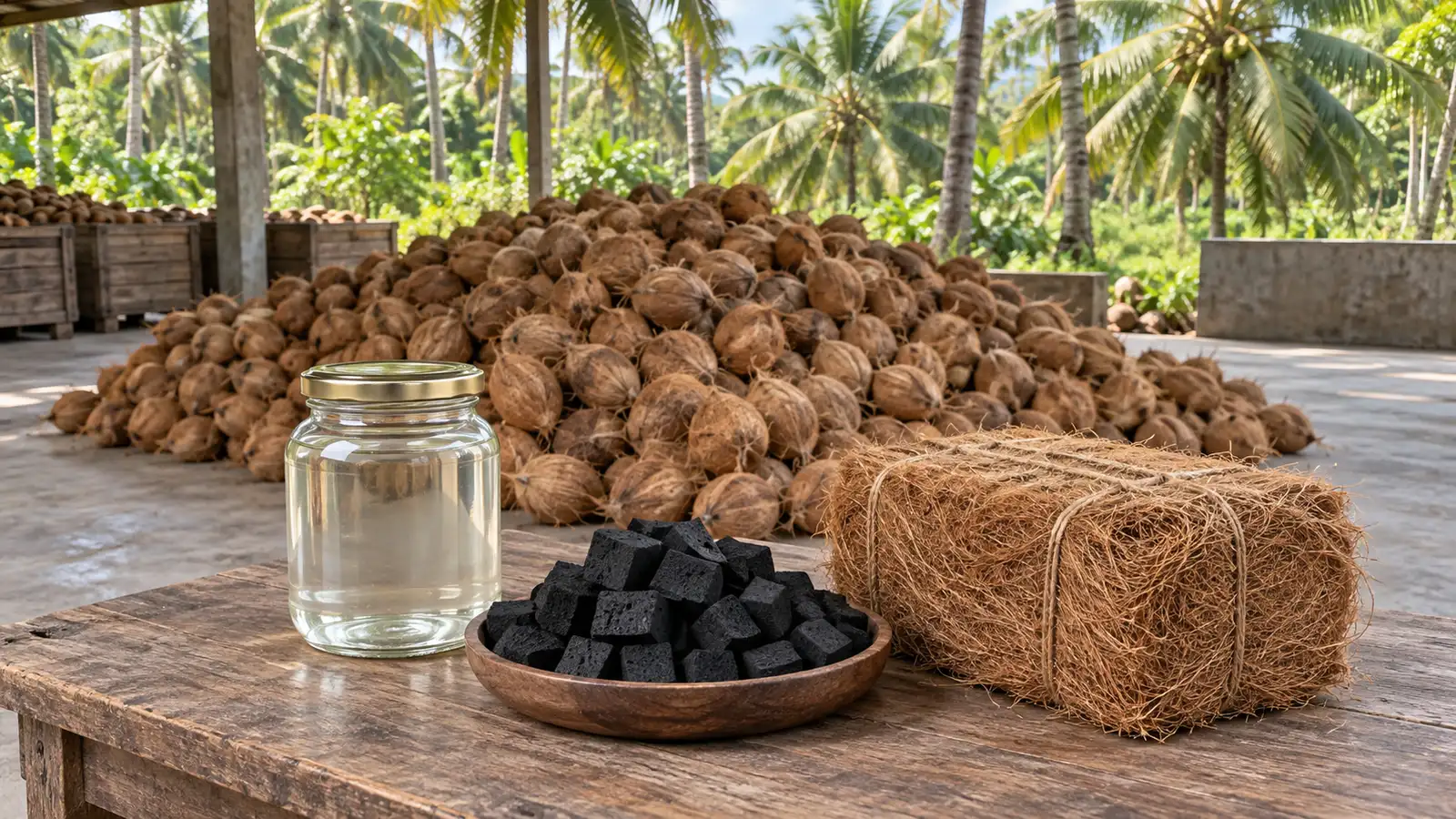
Before you write to coconut products suppliers in Sri Lanka, decide which part of the nut you are buying. Kernel, shell, fibre and peat are separate trades, each with its own grades, test figures and certificates, and a supplier can only quote what you name. This guide sets out the product families, the official figures that exist for each, and the wording that makes one quote comparable with another.
Six product groups, three government bodies
The Export Development Board (EDB) groups Sri Lankan coconut exports into six sets: kernel products, water-based products, fibre (coir) products, shell products, sap-based products and coco peat products. Its overview of the coconut sector also names three government institutions. The Coconut Development Authority (CDA) covers production and quality improvement, the Coconut Cultivation Board covers supply development, and the Coconut Research Institute covers research.
The EDB's export procedure guide of 2020 says exporters of coconut products should be registered with the Coconut Development Authority annually, so ask any supplier to confirm that the registration is current.
The table covers four of the six groups.
| Family | Products the EDB lists | What to name in your enquiry |
|---|---|---|
| Kernel | Desiccated coconut, coconut chips, coconut oil, virgin coconut oil, coconut milk, cream, butter and flour | The oil grade and its free fatty acid limit, or the cut size |
| Shell | Coconut shell charcoal and activated carbon | The form, the end use and the test report you expect |
| Fibre | Coir fibre and coir twine | Brown or white fibre; for twine, the ply and the thickness |
| Coco peat | Grow bags, bricks and briquettes, discs, pellets and loose peat | The form, washed or unwashed, and the electrical conductivity reading |
Kernel products: the oil grades
Two production routes sit behind the words "coconut oil". The EDB's page on coconut kernel products says Sri Lankan coconut oil is mainly made by pressing and filtering copra under a temperature of 70 to 75 Celsius using a screw press. Virgin coconut oil (VCO in trade shorthand) is produced from the white kernel of the coconut through what the EDB calls the "Wet Process". It was introduced as an alternative to the traditional oil derived from copra, and it is a colourless oil.
The Coconut Development Authority's product descriptions separate the grades by raw material and by free fatty acid (FFA) level.
| Grade | Raw material in the CDA description | FFA figure in the CDA description |
|---|---|---|
| Virgin Coconut Oil | Fresh coconut kernel | Maximum fatty acid level of 0.2% |
| White Oil | High-quality copra | Less than 0.8% |
| Pairing Oil | Fresh parings | Maximum of 0.8% |
| Industrial Coconut Oil | Low-grade copra | About 1.5% |
The CDA also lists Refined, Bleached and Deodorized (RBD) coconut oil, made by refining crude coconut oil.
A request for "coconut oil" is therefore not a specification. A buyer weighing virgin coconut oil against white coconut oil is choosing between fresh kernel and copra as the raw material, and between two different FFA ceilings. Name the grade, state the FFA limit you accept, and ask for a certificate of analysis (COA) for the lot on offer.
Kernel products: desiccated coconut
Desiccated coconut, which the EDB shortens to DC, is sold by cut. The EDB says it is made in three standard cut sizes, super-fine, fine and medium, and in fancy cuts such as chips, flakes, threads and shreds.
The international reference is the Codex Standard for Desiccated Coconut (CODEX STAN 177-1991, revised in 2011), which does not cover salted, sugared, flavoured or roasted products. It defines cut sizes by sieve. Fine desiccated coconut is product of which not less than 80% of the weight passes a sieve of 1.40 mm square aperture and a maximum of 20% passes a 0.71 mm sieve. Medium is product of which not less than 90% passes a 2.80 mm sieve and a maximum of 20% passes a 1.40 mm sieve.
The same standard sets chemical requirements of 0.3% m/m total acidity of the extracted oil, measured as lauric acid, 4% m/m moisture and 2.5% m/m ash, and says the colour shall be natural white to light creamy white. If your contract refers to Codex, these are the lines to check on the test report.
One paper is specific to this product. The EDB says each desiccated coconut export shipment must be accompanied by a certificate from the Coconut Development Authority, so ask for a copy with the shipping documents.
Shell products: charcoal, briquettes and activated carbon
The EDB's page on coconut shell products says coconut shell charcoal is produced by burning the shell of fully matured coconuts with a limited supply of air, and that the shell loses about 70% of its weight after it is heated. It names three production methods: the drum method, the pit method and gasifier technology.
Uses differ by form. The Coconut Development Authority says coconut shell charcoal is widely used as an efficient industrial fuel and is also used to produce activated carbon. The EDB says coconut charcoal briquettes are widely used for outdoor and indoor barbeques and domestic heating, and are commonly used in Middle Eastern countries to burn shisha.
Two briquette forms follow from those uses:coconut shell charcoal shisha cubes, also called hookah coals, and coconut shell BBQ briquettes. For either one, state the shape, the size and the end use.
Fixed carbon, ash, moisture and burning time are the figures to compare. Take them from the supplier's test report for the lot you are offered.
The EDB says activated carbon can be manufactured from coconut shell by chemical activation or high-temperature steam activation, and that it is used across many industries to filter undesirable components from liquids or gases. Name the activation method and the application in your enquiry.
Fibre and coco peat
The EDB says coir fibre falls into two main categories, brown and white fibre. Coir twine is mainly 2 ply and 3 ply, with thickness ranging from 3.5mm up to 12mm, so a twine enquiry needs both the ply and the thickness.
The EDB describes coco peat as a non-fibrous, spongy, lightweight, corky material that holds the coir fibre in the coconut husk together, a by-product of coconut fibre extraction. It is exported as compressed grow bags, peat bricks and briquettes, discs, pellets and loose coco peat.
The EDB also says washing with fresh water lowers the electrical conductivity (EC) of coco peat, and that the material can be reused in many instances for up to five years. Ask whether the lot is washed, and ask for the EC reading on the test report.
Certificates and customs: what to ask for in writing
The EDB's export procedure guide says a quality certificate, health certificate, phytosanitary certificate (the plant health certificate), fumigation certificate, HACCP certification for food items and other certificates or test reports should be submitted when the buyer requests them. Nothing on that list is automatic.
For edible coconut products the health certificate comes from the Food Control Administration Unit (FCAU) of Sri Lanka's Ministry of Health, which issues certificates only to establishments registered with it. The FCAU says different countries request different parameters in the health certificate and advises exporters to check the requirements with the importing agent before exporting. In practice, you tell the supplier which parameters your authority wants.
On the customs side, Sri Lanka Customs says a few commodities are liable for export levies depending on the commodity and the HS code, and its list of levies includes a Coconut Cess. Ask whether the quoted price already includes any export levy.
Put the HS code on the enquiry as well. The Department of Commerce explains that the first six digits of an HS code are agreed by all countries, while national tariff lines of eight to ten digits can differ, so give the code your own customs authority uses.
Import rules for food, charcoal and growing media differ by country, and they change. Confirm the requirements with your customs broker or on the authority's own page before you order.
How to brief a supplier in six steps
- Name the family and the product. Kernel, shell, fibre or peat, then the exact item, such as White Oil, desiccated coconut or shisha cubes.
- State the grade, cut or form in official words. An oil grade with its FFA limit, a desiccated coconut cut with its sieve definition, a charcoal shape and size, or a peat form.
- Attach your specification. Say which standard or in-house specification applies, and ask for a COA or test report for the lot.
- List the certificates before packing. Health certificate parameters, the Coconut Development Authority certificate for desiccated coconut, and anything else your market wants.
- Give the commercial details. Quantity, pack type, destination port and the Incoterms rule you prefer (the trade term, such as FOB or CIF). The export procedure guide says the exporter's pro-forma invoice states the product description, quantity, price, terms of payment, terms of delivery and packing and marking details.
- Test a sample, then check the pro-forma invoice line by line. The guide says trade samples are usually sent by airmail. Compare the sample with your specification before you commit.
Common mistakes
- Asking for "coconut oil" with no grade. The CDA's descriptions run from virgin coconut oil at a maximum of 0.2% to industrial oil at about 1.5% FFA. Quotes for different grades cannot be compared.
- Comparing charcoal on price alone. Without a test report for each lot, you are not comparing the same product.
- Assuming certificates arrive unasked. List each one in the enquiry and again in the contract.
- Leaving your own import rules until the cargo is at sea. Check them with your customs broker before the pro-forma invoice is agreed.
Frequently asked questions
Which government bodies stand behind Sri Lanka's coconut industry?
The Export Development Board names three: the Coconut Development Authority for production and quality improvement, the Coconut Cultivation Board for supply development, and the Coconut Research Institute for research.
What is the difference between virgin coconut oil and white coconut oil?
The Coconut Development Authority describes Virgin Coconut Oil as oil made from fresh coconut kernel with a maximum fatty acid level of 0.2%, and White Oil as coconut oil made from high-quality copra with a free fatty acid percentage of less than 0.8%.
Does desiccated coconut from Sri Lanka need a special certificate?
Yes. The Export Development Board says each desiccated coconut export shipment must be accompanied by a certificate from the Coconut Development Authority. Ask the supplier to send a copy with the other shipping documents.
Who issues the health certificate for coconut food products?
The Food Control Administration Unit of Sri Lanka's Ministry of Health issues health certificates for exported food, including coconut products, and only to establishments registered with it. A factory inspection is a pre-requisite for the certificate.
If your enquiry now names a family, a grade or cut, a quantity and a destination port, you can request a quote through the Truly Ceylon how to order page. Ask in the same message for the specification sheet and for the certificates your market needs. The coconut products category shows the items listed on the site.
Key takeaways
- Kernel, shell, fibre and coco peat are separate product families; name the family and the exact product first.
- Coconut oil grades are told apart by raw material and FFA level, so a quote needs both.
- Charcoal and coco peat figures come from the supplier's test report for the lot.
- Certificates are supplied when the buyer asks, so list them in writing before the goods are packed.
Sourcing from Sri Lanka?
Send us the product, quantity, packing and destination port for a written quotation.