Virgin coconut oil vs white coconut oil: what do 0.2% and 0.8% FFA mean for your order?
Truly Ceylon export team ·
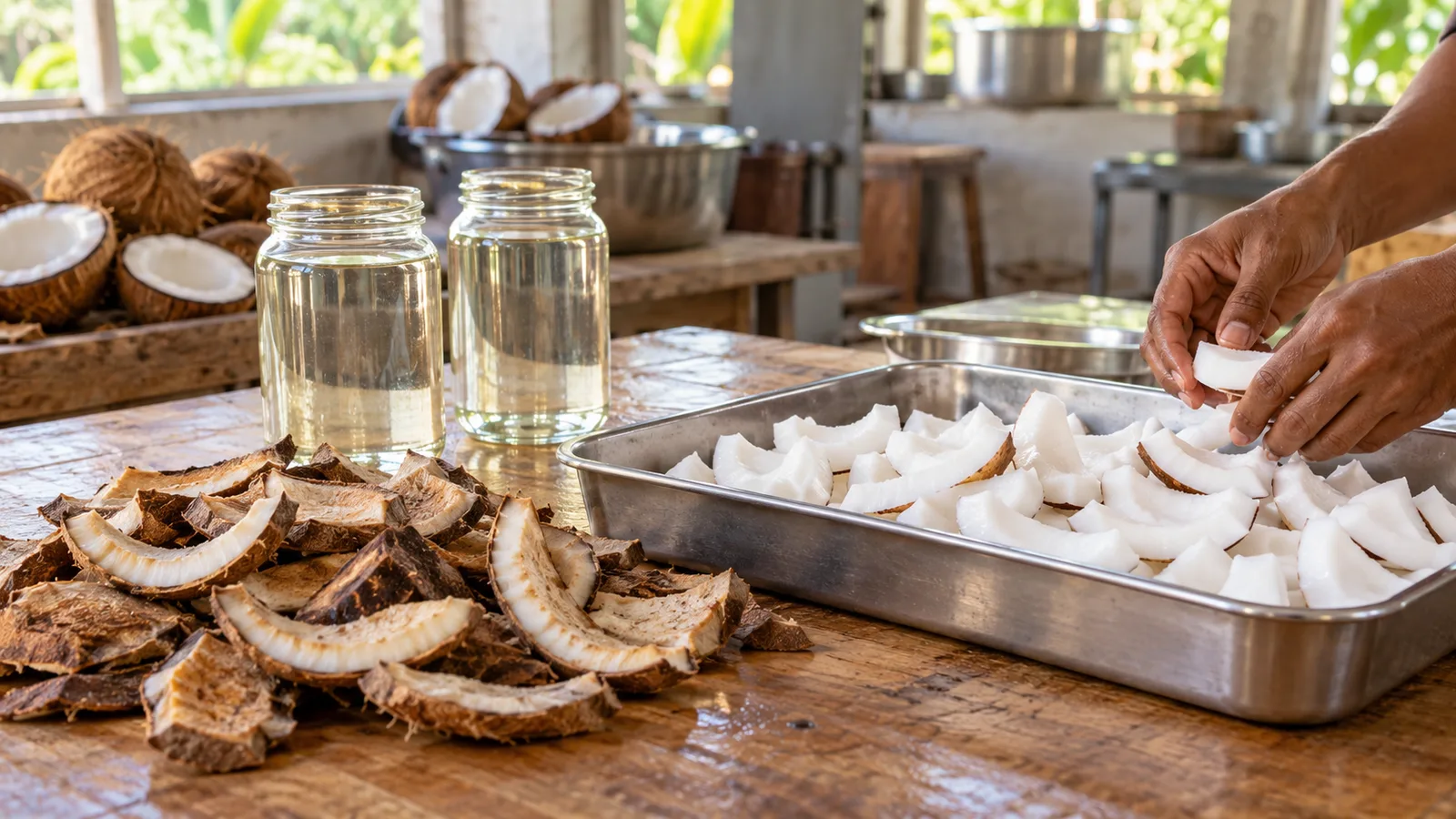
Virgin coconut oil vs white coconut oil is a choice between two raw materials and two acidity limits. Sri Lanka's Coconut Development Authority (CDA) describes virgin coconut oil as oil made from fresh coconut kernel with a maximum fatty acid level of 0.2%, and White Oil as coconut oil made from high-quality copra with a free fatty acid (FFA) percentage of less than 0.8%. Decide which of the two your product needs, write that grade and its FFA ceiling into your enquiry, and ask for a test report for the lot you will receive.
Fresh kernel or copra: where the two oils start
The difference begins before any oil is pressed. Copra is dried coconut kernel. The Export Development Board (EDB), Sri Lanka's export promotion body, says Sri Lankan coconut oil is mainly made by pressing and filtering copra under 70 to 75 Celsius temperature using a screw press. That is the route behind White Oil and the other copra-based grades.
Virgin coconut oil (VCO in everyday trade talk) takes a different path. The EDB says it is produced from the white kernel of the coconut through the "Wet Process", that it was introduced as an alternative to the traditional coconut oil derived from copra, and that it is a colourless oil. The EDB's page on coconut kernel products describes both routes.
So the grade name on your order tells the mill which raw material to use. "Coconut oil" on its own does not, and two quotes for it may not describe the same product.
What 0.2% and 0.8% mean on a spec sheet
FFA is given as a percentage, and a lower ceiling is a tighter limit. The CDA's figure for virgin coconut oil is a maximum of 0.2%; its figure for White Oil is below 0.8%. A lot of White Oil can therefore meet its own grade and still fail a virgin coconut oil specification on this one line.
The CDA's product description for coconut oil is the reference to quote when you set the limits. Write the figure the way the CDA writes it: "FFA not more than 0.2%" for virgin oil, "FFA less than 0.8%" for White Oil. If your market sets a stricter number, write that one instead.
- A spec sheet states what the supplier undertakes to deliver. A test report, or certificate of analysis (COA), records what one lot measured. Ask for both, and check that the COA carries the lot number and date of the oil offered to you.
- The CDA gives one acidity figure for each grade. The official pages we read give no full virgin coconut oil specification for moisture or peroxide value. Any further limits you need belong in your own specification, agreed in writing before the order is confirmed.
| Line on the spec sheet | Virgin coconut oil | White coconut oil | What to ask the supplier |
|---|---|---|---|
| Raw material | Fresh coconut kernel (CDA) | High-quality copra (CDA) | Confirm the raw material in writing |
| Process | "Wet Process" from the white kernel (EDB) | Copra pressed and filtered with a screw press at 70 to 75 Celsius (EDB) | Ask how the lot on offer was made |
| Free fatty acid | Maximum 0.2% (CDA) | Less than 0.8% (CDA) | A COA for your lot showing the FFA result |
| Appearance | Colourless (EDB) | Not stated on the official pages read | State the colour or clarity you accept |
| Other limits | Not published by the CDA | Not published by the CDA | Write your own limits into the specification |
The other coconut oil grades you may see offered
Virgin and white are two of five oils in the CDA's description.
- Refined, Bleached and Deodorized (RBD) coconut oil is made by refining crude coconut oil. An offer that says RBD is a refined product, not virgin oil.
- Pairing Oil is made from fresh parings, with an FFA maximum of 0.8%. Its raw material is neither the whole fresh kernel nor copra.
- Industrial Coconut Oil is made from low-grade copra, with an FFA level of about 1.5%. It is not one of the grades a food buyer specifies.
When two offers name different grades, compare them by raw material and FFA figure, not by the word "coconut". Our overview of coconut products from Sri Lanka covers the shell, fibre and coco peat trades too.
Which oil fits your buyers
Start from the product you will sell, not from the oil. Truly Ceylon's virgin coconut oil page describes the oil as obtained from the fresh kernel of the coconut, Cocos nucifera, without refining, bleaching or deodorising. It names food manufacturers, bakeries, retailers, cosmetic and personal care formulators and soap makers as its buyers.
A retailer selling bottled oil under the words "virgin coconut oil" needs the virgin grade, because the label makes that statement. Where neither the label nor the formula calls for virgin oil, the white coconut oil product page is the other edible oil on this site to compare.
Keep labels to what the oil is: the grade, the origin and the raw material. Do not carry over any health wording from an offer, a brochure or a supplier's website. Those claims are regulated in each market, and in the United States the FDA says a product represented for the treatment, prevention or cure of a specific disease is treated as a drug.
Papers that travel with a coconut oil order
The EDB's export procedure guide (2020) says exporters of coconut products should be registered with the CDA annually. Ask the supplier to confirm that the registration is current for the year of your shipment.
The health certificate for exported food comes from the Food Control Administration Unit (FCAU) of Sri Lanka's Ministry of Health, which issues export health certificates for coconut products among other foods. It issues them only to establishments registered with it, and a factory inspection is a pre-requisite. For each consignment it asks for an application, a sample and analysis reports, and usually tests the sample first. The steps are on the FCAU's export certification page.
The FCAU also says different countries request different parameters in the health certificate. Tell the supplier which parameters your authority expects.
Other papers depend on your request. The same EDB guide says quality certificates, health certificates, HACCP certification for food items and other certificates or test reports are submitted when the buyer requests them, and that quality certificates are issued by accredited quality firms such as SLSI, ITI and SGS Lanka. Our checklist of export documents from Sri Lanka separates the standard shipping set from the papers you must ask for.
On the Sri Lankan side, Sri Lanka Customs says a few commodities are liable for export levies depending on the commodity and the HS code, and its list includes a Coconut Cess. Agree the HS code with the supplier and your customs broker before the pro-forma invoice is issued.
Rules at your end of the shipment
Your own market decides what must happen before the oil is released. Some examples:
- United States. Facilities that manufacture, process, pack or hold food for US consumption must register with the FDA. FDA guidance says prior notice must be confirmed no less than 8 hours before arrival by water and 4 hours before arrival by air, and the importer must follow a Foreign Supplier Verification Program for each food. The details are on the FDA's prior notice page.
- Canada. The Canadian Food Inspection Agency says a licence is required to import food, and a preventive control plan is part of that licence.
- Japan. Under Article 27 of the Food Sanitation Act, food imported for sale or business use needs an import notification on each occasion.
- Australia. Imported food must comply with Australia's food standards and may be referred to the Imported Food Inspection Scheme at the border.
These rules change: confirm them with your customs broker or the authority before you order. For more markets, see our guide to destination rules for Sri Lankan food imports.
How to specify coconut oil in a quote request
- Name the grade in the CDA's words, "Virgin Coconut Oil" or "White Oil", and add the raw material: fresh coconut kernel or copra.
- Write the FFA limit: not more than 0.2% for virgin oil, less than 0.8% for White Oil, or the stricter figure your market sets.
- Ask for the specification sheet and a COA for the lot on offer, with the lot number and test date.
- State the quantity, whether it is a one-off or a repeat order, the pack size and packing type, and the destination port.
- Choose the Incoterms rule. For sea freight FOB, CFR and CIF are common; our guide to the eleven Incoterms 2020 rules shows who pays and insures what under each.
- List the certificates and test reports your authority requires, including the parameters for the health certificate.
- Agree the specification and labelling in writing before you confirm the order.
Common mistakes
- Ordering "coconut oil" with no grade.
- Accepting "low FFA" in place of a number. Write 0.2% or 0.8%, or your own figure, so the COA can be checked against it.
- Reading an old test report as proof for a new lot. Ask for a COA tied to your shipment.
- Treating RBD or Pairing Oil as virgin oil. One is refined from crude oil and the other is made from parings; check the grade name on the offer and on the invoice.
- Copying health claims onto your label.
Frequently asked questions
What is the FFA limit for virgin coconut oil from Sri Lanka?
The Coconut Development Authority describes virgin coconut oil as oil made from fresh coconut kernel with a maximum fatty acid level of 0.2%. Write that limit into your specification and check it on the test report.
Is white coconut oil the same as refined coconut oil?
No. The CDA lists them as separate grades. White Oil is made from high-quality copra with an FFA percentage of less than 0.8%, while RBD coconut oil is made by refining crude coconut oil.
How is virgin coconut oil made differently from copra oil?
The EDB says virgin coconut oil is produced from the white kernel through the "Wet Process", while Sri Lankan coconut oil is mainly made by pressing and filtering copra at 70 to 75 Celsius with a screw press.
Which health certificate does a coconut oil shipment need?
Export health certificates for coconut products are issued by the FCAU of the Ministry of Health, only to registered establishments and after a factory inspection. Tell the supplier which parameters your authority expects.
Does the supplier need to be registered with the Coconut Development Authority?
The EDB's export procedure guide says exporters of coconut products should be registered with the CDA annually. Ask the supplier to confirm it is current.
Once you know the grade, the FFA limit and the papers your market needs, put them in one message and follow the steps on the Truly Ceylon how-to-order page. Both oils are listed in the coconut products category, and the written quotation answers for the grade and quantity you describe.
Key takeaways
- Virgin coconut oil comes from fresh kernel by the wet process; White Oil comes from copra pressed with a screw press.
- The CDA's FFA figures are a maximum of 0.2% for virgin oil and less than 0.8% for White Oil.
- RBD, Pairing Oil and Industrial Coconut Oil are separate grades; compare offers by grade name and FFA.
- Name the health-certificate parameters and other papers your market needs before the order is confirmed.
Sourcing from Sri Lanka?
Send us the product, quantity, packing and destination port for a written quotation.